
Wednesday, June 17, 2026
Phew & Danielle de Picciotto: Paper Masks
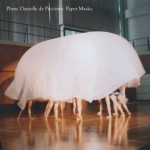


Two artists who have spent decades dismantling the obvious decide, at some point, to exchange voices across continents and see what survives the journey. Predictably, "Paper Masks" does not aim for clarity. It prefers interference.
On one side, Phew, a figure who has been quietly reshaping the edges of electronic and post-punk language since her days in Aunt Sally. On the other, Danielle de Picciotto, whose biography alone reads like a small cultural ecosystem, from co-founding the Love Parade to weaving text, performance, and sound into something that resists stable categorization. Put them together, then separate them again geographically, and you get an album built on distance itself.
The working method is almost suspiciously simple: voice sent from Berlin, music shaped in Japan, minimal negotiation between the two. In less patient hands, this could have produced a polite collage. Instead, it feels like a series of transmissions that occasionally align and more often graze past each other, leaving sparks.
The opening stretch establishes the album’s central tension: language as material versus language as meaning. De Picciotto’s spoken word doesn’t sit “on top” of Phew’s electronics. It gets folded, stretched, sometimes gently sabotaged. German phrases arrive with a certain weight, then dissolve into texture before they can fully declare themselves. Phew’s own voice enters not as a counterpart but as a parallel current, less concerned with articulation than with presence. The result is less dialogue than overlapping solitudes.
Tracks like "Der Verpasste Kaffee" and "Amnesie" toy with minimalism, but not the serene, gallery-friendly kind. Silence here is unstable, always on the verge of being punctured by sudden electronic ruptures. There’s a sense that the music is testing how little structure it can maintain before it collapses, then pulling back just in time. It’s controlled, but only just.
"Sugar Sprinkles" pushes things further into disorientation. The voices fragment, multiply, blur into something almost post-human. If you were hoping for a comforting narrative thread, this is where it politely evaporates. What remains is rhythm as suggestion, speech as residue, identity as something temporarily misplaced.
Elsewhere, "Pixelwissen" and "Iceberg" expand the spatial dimension of the record. The sound design grows more architectural, less concerned with immediacy and more with scale. You get the impression of vast, empty interiors where voices echo not to communicate, but to confirm that space exists at all. It’s oddly physical music for something assembled through file exchanges.
Then there’s "Paper Memories", one of the more fragile moments, where the distance between the two artists feels almost tender rather than alienating. The piece hovers, unsure whether to cohere, and that hesitation becomes its emotional core. By the time "Im Nebel" closes the album, the fog metaphor is impossible to ignore, though thankfully never overexplained. Things fade, but not dramatically. More like a signal weakening.
What makes "Paper Masks" compelling is not innovation in the loud, attention-seeking sense. Both artists have done radical things before. Here, the interest lies in restraint and in the decision to let misalignment remain audible. The “mask” of the title doesn’t conceal identity so much as reveal how unstable it already is, especially when filtered through language, distance, and technology.
In a cultural moment obsessed with immediacy and clean communication, "Paper Masks" lingers in the opposite direction. It suggests that what fails to connect might be just as interesting as what does. Not a comforting thought, but an honest one.
On one side, Phew, a figure who has been quietly reshaping the edges of electronic and post-punk language since her days in Aunt Sally. On the other, Danielle de Picciotto, whose biography alone reads like a small cultural ecosystem, from co-founding the Love Parade to weaving text, performance, and sound into something that resists stable categorization. Put them together, then separate them again geographically, and you get an album built on distance itself.
The working method is almost suspiciously simple: voice sent from Berlin, music shaped in Japan, minimal negotiation between the two. In less patient hands, this could have produced a polite collage. Instead, it feels like a series of transmissions that occasionally align and more often graze past each other, leaving sparks.
The opening stretch establishes the album’s central tension: language as material versus language as meaning. De Picciotto’s spoken word doesn’t sit “on top” of Phew’s electronics. It gets folded, stretched, sometimes gently sabotaged. German phrases arrive with a certain weight, then dissolve into texture before they can fully declare themselves. Phew’s own voice enters not as a counterpart but as a parallel current, less concerned with articulation than with presence. The result is less dialogue than overlapping solitudes.
Tracks like "Der Verpasste Kaffee" and "Amnesie" toy with minimalism, but not the serene, gallery-friendly kind. Silence here is unstable, always on the verge of being punctured by sudden electronic ruptures. There’s a sense that the music is testing how little structure it can maintain before it collapses, then pulling back just in time. It’s controlled, but only just.
"Sugar Sprinkles" pushes things further into disorientation. The voices fragment, multiply, blur into something almost post-human. If you were hoping for a comforting narrative thread, this is where it politely evaporates. What remains is rhythm as suggestion, speech as residue, identity as something temporarily misplaced.
Elsewhere, "Pixelwissen" and "Iceberg" expand the spatial dimension of the record. The sound design grows more architectural, less concerned with immediacy and more with scale. You get the impression of vast, empty interiors where voices echo not to communicate, but to confirm that space exists at all. It’s oddly physical music for something assembled through file exchanges.
Then there’s "Paper Memories", one of the more fragile moments, where the distance between the two artists feels almost tender rather than alienating. The piece hovers, unsure whether to cohere, and that hesitation becomes its emotional core. By the time "Im Nebel" closes the album, the fog metaphor is impossible to ignore, though thankfully never overexplained. Things fade, but not dramatically. More like a signal weakening.
What makes "Paper Masks" compelling is not innovation in the loud, attention-seeking sense. Both artists have done radical things before. Here, the interest lies in restraint and in the decision to let misalignment remain audible. The “mask” of the title doesn’t conceal identity so much as reveal how unstable it already is, especially when filtered through language, distance, and technology.
In a cultural moment obsessed with immediacy and clean communication, "Paper Masks" lingers in the opposite direction. It suggests that what fails to connect might be just as interesting as what does. Not a comforting thought, but an honest one.
Comments
Stream
Browse by Genre
Industrial Music / Industrial Metal / Aggro Industrial / Electro Metal
Industrial Noise / Power Noise / Harsh Noise
Synth Pop / Electro Pop / Synth-Electronica
Techno / Trance / Goa / Drum'n'Bass / Jungle / Tribal / Trip-Hop
Ambient / Electronica / Ethereal / Dub / Soundscapes / Abstract
Experimental / Avantgarde / Weird & Wired / Glitch / Noise / Field Recording
Dark / Gothic / Wave / New Wave / Dark Wave / Industrial Gothic
New Music / Downtown / Avantgarde Jazz / New Classical / World