
Friday, September 25, 2026
XII Sound: Tube V
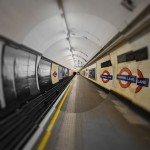
Artist: XII Sound
Title: Tube V
Format: Download Only (MP3 + Lossless)
Label: Driftworks/Audiobulb (@)
Rated:

Title: Tube V
Format: Download Only (MP3 + Lossless)
Label: Driftworks/Audiobulb (@)
Rated:
Public transport is rarely described as a site of intimacy. More often it’s a shared inconvenience, a moving container of mild irritation and suppressed eye contact. Yet for Alice DeVille, working under the name XII Sound, the London Underground becomes something stranger: a nervous system, a memory archive, and, inconveniently, a source of anxiety.
"Tube V", released as part of the SITE series by Driftworks and Audiobulb, is built from that contradiction. Fear and familiarity occupy the same acoustic space, and instead of resolving the tension, DeVille leans into it. The result is not quite a document, not quite a composition. More like a set of controlled exposures, where the artist repeatedly enters the environment that unsettles her and listens until it begins to change shape.
DeVille’s background as an opera singer and flautist is not incidental here. You can hear it in the way she treats sound as something physical, embodied, almost architectural. But instead of projecting into grand halls, her voice folds itself into tunnels, compressing, echoing, blending with mechanical noise. At times, she quite literally duets with the infrastructure. Which sounds poetic until you realize the infrastructure is a train braking at high frequency.
The opening sequence - “Tube I” through “Tube IV” - functions like a gradual descent. Snippets of announcements, metallic rhythms, fragments of conversation, and processed environmental sounds begin to overlap. DeVille introduces natural elements—birdsong, water, subtle field textures—not as contrast but as camouflage. The boundaries blur. Is that a train or a breath? A rail screech or a manipulated voice? The uncertainty is deliberate, and slightly disorienting.
By the time we reach “Tube V”, the album’s conceptual core becomes clearer. The space is no longer purely external. The tube has been internalized, transformed into a kind of resonant chamber where memory, panic, and nostalgia circulate. The childhood recollection of falling asleep to train sounds coexists with the adult experience of claustrophobia. Comfort and dread share the same frequency band.
The closing piece, “Tube I–V”, gathers these fragments into a longer form, less a summary than a reconfiguration. Motifs reappear, textures overlap more densely, and the listening experience becomes almost spatial. You don’t just hear the work; you seem to move through it, as if the tunnels had been reassembled inside your head.
Technically, the album sits somewhere between microsound, ambient composition, and electroacoustic collage. But labels feel slightly inadequate here. What matters more is the method: recording, sampling, reshaping, and recontextualizing everyday sounds until they reveal hidden emotional contours. DeVille’s use of tools like Ableton’s Simpler is not about virtuosity but about transformation. The mundane becomes unstable, then strangely expressive.
There’s also an undercurrent of ecological thinking running through the work. By blending natural and industrial sounds so thoroughly, DeVille resists the easy binary between “organic” and “artificial”. The city is not separate from nature; it is another ecosystem, just louder and less forgiving. "Tube V" suggests that reconnection might not come from escaping these environments, but from listening to them more carefully. Which is a slightly uncomfortable proposition, given how most people experience rush hour.
What prevents the album from becoming a purely conceptual exercise is its emotional honesty. The fear is not aestheticized into something neat. It lingers, unresolved. But alongside it, there is curiosity, even tenderness. The tube is not only a site of panic; it is also a place of memory, of rhythm, of accidental music.
In the end, "Tube V" feels like a negotiation. Between body and architecture, between control and overwhelm, between the human voice and the mechanical systems that surround it.
Not the most relaxing commute you’ll ever take. But certainly one of the more revealing.
"Tube V", released as part of the SITE series by Driftworks and Audiobulb, is built from that contradiction. Fear and familiarity occupy the same acoustic space, and instead of resolving the tension, DeVille leans into it. The result is not quite a document, not quite a composition. More like a set of controlled exposures, where the artist repeatedly enters the environment that unsettles her and listens until it begins to change shape.
DeVille’s background as an opera singer and flautist is not incidental here. You can hear it in the way she treats sound as something physical, embodied, almost architectural. But instead of projecting into grand halls, her voice folds itself into tunnels, compressing, echoing, blending with mechanical noise. At times, she quite literally duets with the infrastructure. Which sounds poetic until you realize the infrastructure is a train braking at high frequency.
The opening sequence - “Tube I” through “Tube IV” - functions like a gradual descent. Snippets of announcements, metallic rhythms, fragments of conversation, and processed environmental sounds begin to overlap. DeVille introduces natural elements—birdsong, water, subtle field textures—not as contrast but as camouflage. The boundaries blur. Is that a train or a breath? A rail screech or a manipulated voice? The uncertainty is deliberate, and slightly disorienting.
By the time we reach “Tube V”, the album’s conceptual core becomes clearer. The space is no longer purely external. The tube has been internalized, transformed into a kind of resonant chamber where memory, panic, and nostalgia circulate. The childhood recollection of falling asleep to train sounds coexists with the adult experience of claustrophobia. Comfort and dread share the same frequency band.
The closing piece, “Tube I–V”, gathers these fragments into a longer form, less a summary than a reconfiguration. Motifs reappear, textures overlap more densely, and the listening experience becomes almost spatial. You don’t just hear the work; you seem to move through it, as if the tunnels had been reassembled inside your head.
Technically, the album sits somewhere between microsound, ambient composition, and electroacoustic collage. But labels feel slightly inadequate here. What matters more is the method: recording, sampling, reshaping, and recontextualizing everyday sounds until they reveal hidden emotional contours. DeVille’s use of tools like Ableton’s Simpler is not about virtuosity but about transformation. The mundane becomes unstable, then strangely expressive.
There’s also an undercurrent of ecological thinking running through the work. By blending natural and industrial sounds so thoroughly, DeVille resists the easy binary between “organic” and “artificial”. The city is not separate from nature; it is another ecosystem, just louder and less forgiving. "Tube V" suggests that reconnection might not come from escaping these environments, but from listening to them more carefully. Which is a slightly uncomfortable proposition, given how most people experience rush hour.
What prevents the album from becoming a purely conceptual exercise is its emotional honesty. The fear is not aestheticized into something neat. It lingers, unresolved. But alongside it, there is curiosity, even tenderness. The tube is not only a site of panic; it is also a place of memory, of rhythm, of accidental music.
In the end, "Tube V" feels like a negotiation. Between body and architecture, between control and overwhelm, between the human voice and the mechanical systems that surround it.
Not the most relaxing commute you’ll ever take. But certainly one of the more revealing.
Comments
Stream
Browse by Genre
Industrial Music / Industrial Metal / Aggro Industrial / Electro Metal
Industrial Noise / Power Noise / Harsh Noise
Synth Pop / Electro Pop / Synth-Electronica
Techno / Trance / Goa / Drum'n'Bass / Jungle / Tribal / Trip-Hop
Ambient / Electronica / Ethereal / Dub / Soundscapes / Abstract
Experimental / Avantgarde / Weird & Wired / Glitch / Noise / Field Recording
Dark / Gothic / Wave / New Wave / Dark Wave / Industrial Gothic
New Music / Downtown / Avantgarde Jazz / New Classical / World