
Armando Balice: Du noir tout autour
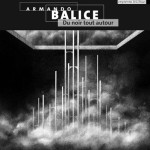
Artist: Armando Balice (@)
Title: Du noir tout autour
Format: CD
Label: empreintes DIGITALes (@)
Rated:

Title: Du noir tout autour
Format: CD
Label: empreintes DIGITALes (@)
Rated:
This is one of those records that doesn’t arrive so much as surround you. You don’t press play and wait for something to happen. You step inside, and the light politely excuses itself.
"Du noir tout autour" is Armando Balice doing what he does best, which is treating darkness not as mood, but as material. Not metaphorical gloom, not cinematic dread, but darkness as a working condition. As substance. As a space where sound has to earn its right to exist. This is acousmatic music that remembers where it came from: microphones out in the world, analogue oscillations with rough edges still showing, edited with care but never sanded down to politeness.
Balice has been circling this territory for years. A French-Italian composer shaped by Ina-GRM and the lineage of Denis Dufour and Jean-Marc Weber, he carries both the discipline of electroacoustic tradition and a taste for density that flirts openly with noise, metal, and orchestral mass. His music often sounds like it wants to be larger than the speakers that contain it. This album is no exception.
The record is built as a triptych, three long-form works that function like different angles on the same inner landscape. Black Garden, Empty Garden, Light Garden. The titles might suggest a neat progression, but the experience is less linear than that. Darkness doesn’t disappear. It reorganizes.
"Black Garden" opens the set with a sense of dramatic restraint. Field recordings, ravens, forest textures, and the cello of Lola Malique are not presented as scenery, but as unstable elements. Silence and noise keep interrupting each other, like tectonic plates that never quite lock into place. The short “noir” movements puncture the flow, brief moments where the ground seems to drop out entirely. It feels calm only if you mistake stillness for safety.
"Empty Garden" is the most unsettling of the three. Here, emptiness is not absence. It’s pressure. A void that hums quietly with potential. Sounds emerge cautiously, hover, then withdraw, leaving afterimages behind. There’s something almost physical about the way Balice lets space breathe, then compresses it again. This is not ambient comfort. It’s the kind of quiet that makes you aware of your own listening.
By the time "Light Garden" arrives, the title risks optimism, but Balice avoids that trap. Light here is not resolution. It’s exposure. Refractions, iridescent textures, and spectral reflections rise from the same dark matter as before. The cello reappears, birds return, synthetic tones stretch and fracture. Light and shadow coexist, inseparable, like two sides of the same sound.
What stands out across the album is Balice’s sense of form. These pieces collapse and rebuild themselves constantly. Elevations fall. Ruins reorganize. It feels architectural, but unstable, like a structure designed to test how much imbalance it can survive. Editing plays as big a role as sound generation, but the edits never feel surgical. They feel like collisions.
There’s a quiet humor buried in all this severity. Not jokes, but a kind of wry awareness. The idea that in the dark you can see more than you expect. That monochrome surfaces hide complex materials. That a flock of birds and a cello can share a space without explanation. Balice doesn’t underline these moments. He lets them happen and trusts the listener to notice.
"Du noir tout autour" is not an easy record, and it has no interest in being one. It demands attention, patience, and a willingness to let images form slowly, then dissolve. But it’s also deeply lyrical in its own abrasive way. A reminder that darkness is not the opposite of clarity. Sometimes it’s the only place where things come into focus at all.
"Du noir tout autour" is Armando Balice doing what he does best, which is treating darkness not as mood, but as material. Not metaphorical gloom, not cinematic dread, but darkness as a working condition. As substance. As a space where sound has to earn its right to exist. This is acousmatic music that remembers where it came from: microphones out in the world, analogue oscillations with rough edges still showing, edited with care but never sanded down to politeness.
Balice has been circling this territory for years. A French-Italian composer shaped by Ina-GRM and the lineage of Denis Dufour and Jean-Marc Weber, he carries both the discipline of electroacoustic tradition and a taste for density that flirts openly with noise, metal, and orchestral mass. His music often sounds like it wants to be larger than the speakers that contain it. This album is no exception.
The record is built as a triptych, three long-form works that function like different angles on the same inner landscape. Black Garden, Empty Garden, Light Garden. The titles might suggest a neat progression, but the experience is less linear than that. Darkness doesn’t disappear. It reorganizes.
"Black Garden" opens the set with a sense of dramatic restraint. Field recordings, ravens, forest textures, and the cello of Lola Malique are not presented as scenery, but as unstable elements. Silence and noise keep interrupting each other, like tectonic plates that never quite lock into place. The short “noir” movements puncture the flow, brief moments where the ground seems to drop out entirely. It feels calm only if you mistake stillness for safety.
"Empty Garden" is the most unsettling of the three. Here, emptiness is not absence. It’s pressure. A void that hums quietly with potential. Sounds emerge cautiously, hover, then withdraw, leaving afterimages behind. There’s something almost physical about the way Balice lets space breathe, then compresses it again. This is not ambient comfort. It’s the kind of quiet that makes you aware of your own listening.
By the time "Light Garden" arrives, the title risks optimism, but Balice avoids that trap. Light here is not resolution. It’s exposure. Refractions, iridescent textures, and spectral reflections rise from the same dark matter as before. The cello reappears, birds return, synthetic tones stretch and fracture. Light and shadow coexist, inseparable, like two sides of the same sound.
What stands out across the album is Balice’s sense of form. These pieces collapse and rebuild themselves constantly. Elevations fall. Ruins reorganize. It feels architectural, but unstable, like a structure designed to test how much imbalance it can survive. Editing plays as big a role as sound generation, but the edits never feel surgical. They feel like collisions.
There’s a quiet humor buried in all this severity. Not jokes, but a kind of wry awareness. The idea that in the dark you can see more than you expect. That monochrome surfaces hide complex materials. That a flock of birds and a cello can share a space without explanation. Balice doesn’t underline these moments. He lets them happen and trusts the listener to notice.
"Du noir tout autour" is not an easy record, and it has no interest in being one. It demands attention, patience, and a willingness to let images form slowly, then dissolve. But it’s also deeply lyrical in its own abrasive way. A reminder that darkness is not the opposite of clarity. Sometimes it’s the only place where things come into focus at all.
Comments
Stream
Browse by Genre
Industrial Music / Industrial Metal / Aggro Industrial / Electro Metal
Industrial Noise / Power Noise / Harsh Noise
Synth Pop / Electro Pop / Synth-Electronica
Techno / Trance / Goa / Drum'n'Bass / Jungle / Tribal / Trip-Hop
Ambient / Electronica / Ethereal / Dub / Soundscapes / Abstract
Experimental / Avantgarde / Weird & Wired / Glitch / Noise / Field Recording
Dark / Gothic / Wave / New Wave / Dark Wave / Industrial Gothic
New Music / Downtown / Avantgarde Jazz / New Classical / World