
Sunday, October 11, 2026
Pablo Diserens: Ebbing Ice Lines
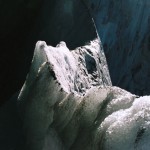
Artist: Pablo Diserens (@)
Title: Ebbing Ice Lines
Format: 12" x 2 + Download
Label: Forms of Minutiae (@)
Rated:

Title: Ebbing Ice Lines
Format: 12" x 2 + Download
Label: Forms of Minutiae (@)
Rated:
There are records that document a place, and then there are records that listen back to it. "Ebbing Ice Lines" belongs firmly to the second category. Pablo Diserens doesn’t arrive in the Low Arctic as a narrator, a mourner, or a moral lecturer; he arrives as an ear pressed gently - sometimes uncomfortably - against the body of ice itself. What comes back is not a message in any human language, but a dense, murmuring presence that refuses to stay symbolic for long.
Diserens, co-founder of forms of minutiae and a figure deeply embedded in contemporary ecoacoustic practice, has long worked at the threshold where field recording stops being documentation and starts behaving like composition. Here, that threshold dissolves almost completely. Across this double LP, glaciers are not treated as scenic backdrops or frozen archives waiting to be decoded, but as active, metabolizing entities. They gurgle, exhale, rasp, fizz, and occasionally seem to chuckle darkly at our insistence on meaning.
The opening “melt morphemes (supraglacial)” sets the tone immediately: pops and crackles from trapped air bubbles collapse geological time into an almost playful immediacy. It’s strangely intimate - less the sound of catastrophe than of a body quietly adjusting to change. That intimacy deepens throughout the record, especially in moments where the boundary between natural and anthropogenic blurs. Distant drones from ships or infrastructure don’t feel like intrusions; they settle into the sound field like unwanted but now unavoidable organs.
What’s striking is how un-dramatic much of the album is, despite its subject matter. This is not an elegy dressed up as sonic spectacle. Tracks like the title piece or “non-night over pseudocraters” move with a glacial patience that resists narrative payoff. The sounds don’t build toward revelation; they hover, circulate, and persist. Listening becomes less about following a trajectory and more about surrendering to scale - temporal, spatial, and emotional.
Diserens’ compositional choices emphasize proximity over panorama. Instead of sweeping Arctic vistas, we’re placed inside crevasses, near moulins, alongside dripping surfaces and submerged ice fragments. By the time “melt morphemes (proglacial)” arrives, the ear has been recalibrated so thoroughly that the low, breathing growls of ice in water feel uncannily human. It’s an unsettling moment, not because it sentimentalizes nature, but because it reminds us how fragile our distinctions really are.
The inclusion of volcanic material on “world in the process of making itself” widens the frame without diluting the focus. Geological forces converse across states - solid, liquid, gaseous - suggesting a continuum rather than a hierarchy. This is where Diserens’ broader philosophical stance becomes audible: sound as a way of thinking with the world, not about it. The album doesn’t ask us to save the glaciers; it asks us to notice them, to accept that attention itself is already a political act.
By the closing “mapping moulins”, the record has subtly altered the listener’s posture. The final drips and flows don’t resolve anything; they simply continue, indifferent to our listening yet somehow changed by it. "Ebbing Ice Lines" is not a warning siren, nor a requiem. It’s a sustained act of presence, one that treats listening as a form of coexistence rather than control.
In a cultural moment saturated with climate metaphors and apocalyptic shortcuts, Diserens offers something rarer and more demanding: patience, humility, and the quiet audacity to let ice speak without subtitles. The result is a record that doesn’t melt your heart - but slowly, persistently, erodes the assumptions you brought with you.
Diserens, co-founder of forms of minutiae and a figure deeply embedded in contemporary ecoacoustic practice, has long worked at the threshold where field recording stops being documentation and starts behaving like composition. Here, that threshold dissolves almost completely. Across this double LP, glaciers are not treated as scenic backdrops or frozen archives waiting to be decoded, but as active, metabolizing entities. They gurgle, exhale, rasp, fizz, and occasionally seem to chuckle darkly at our insistence on meaning.
The opening “melt morphemes (supraglacial)” sets the tone immediately: pops and crackles from trapped air bubbles collapse geological time into an almost playful immediacy. It’s strangely intimate - less the sound of catastrophe than of a body quietly adjusting to change. That intimacy deepens throughout the record, especially in moments where the boundary between natural and anthropogenic blurs. Distant drones from ships or infrastructure don’t feel like intrusions; they settle into the sound field like unwanted but now unavoidable organs.
What’s striking is how un-dramatic much of the album is, despite its subject matter. This is not an elegy dressed up as sonic spectacle. Tracks like the title piece or “non-night over pseudocraters” move with a glacial patience that resists narrative payoff. The sounds don’t build toward revelation; they hover, circulate, and persist. Listening becomes less about following a trajectory and more about surrendering to scale - temporal, spatial, and emotional.
Diserens’ compositional choices emphasize proximity over panorama. Instead of sweeping Arctic vistas, we’re placed inside crevasses, near moulins, alongside dripping surfaces and submerged ice fragments. By the time “melt morphemes (proglacial)” arrives, the ear has been recalibrated so thoroughly that the low, breathing growls of ice in water feel uncannily human. It’s an unsettling moment, not because it sentimentalizes nature, but because it reminds us how fragile our distinctions really are.
The inclusion of volcanic material on “world in the process of making itself” widens the frame without diluting the focus. Geological forces converse across states - solid, liquid, gaseous - suggesting a continuum rather than a hierarchy. This is where Diserens’ broader philosophical stance becomes audible: sound as a way of thinking with the world, not about it. The album doesn’t ask us to save the glaciers; it asks us to notice them, to accept that attention itself is already a political act.
By the closing “mapping moulins”, the record has subtly altered the listener’s posture. The final drips and flows don’t resolve anything; they simply continue, indifferent to our listening yet somehow changed by it. "Ebbing Ice Lines" is not a warning siren, nor a requiem. It’s a sustained act of presence, one that treats listening as a form of coexistence rather than control.
In a cultural moment saturated with climate metaphors and apocalyptic shortcuts, Diserens offers something rarer and more demanding: patience, humility, and the quiet audacity to let ice speak without subtitles. The result is a record that doesn’t melt your heart - but slowly, persistently, erodes the assumptions you brought with you.
Comments
Stream
Browse by Genre
Industrial Music / Industrial Metal / Aggro Industrial / Electro Metal
Industrial Noise / Power Noise / Harsh Noise
Synth Pop / Electro Pop / Synth-Electronica
Techno / Trance / Goa / Drum'n'Bass / Jungle / Tribal / Trip-Hop
Ambient / Electronica / Ethereal / Dub / Soundscapes / Abstract
Experimental / Avantgarde / Weird & Wired / Glitch / Noise / Field Recording
Dark / Gothic / Wave / New Wave / Dark Wave / Industrial Gothic
New Music / Downtown / Avantgarde Jazz / New Classical / World