
PRAED orchestra!: The Dictionary of Lost Meanings
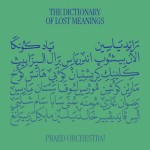
Artist: PRAED orchestra! (http://www.paed.ch/praed/) (@)
Title: The Dictionary of Lost Meanings
Format: 12" x 2 + Download
Label: Discrepant (@)
Rated:

Title: The Dictionary of Lost Meanings
Format: 12" x 2 + Download
Label: Discrepant (@)
Rated:
With "The Dictionary of Lost Meanings", PRAED orchestra! pull off something rare: they widen the field without thinning it out. On the contrary - every new musician entering the room makes the air heavier. This is a record that doesn’t ask for permission and doesn’t hand out easy explanations, but takes you by the hand the way certain oral tales do: you start from one story, end up in another, and somewhere in between you get lost - which, really, is the whole point.
Raed Yassin and Paed Conca, the shifting core of the PRAED project, have spent years cultivating a fertile friction: urban Arab tradition (shaabi, popular melodies, collective memory) rubbing up against radical improvisation, free jazz, and crooked electronics. Here, though, the duo step into the role of architects. The orchestra is neither ornament nor power display, but a living organism that breathes, stumbles, dances. The result doesn’t sound big in a symphonic sense; it sounds crowded - like a market, a radio picking up several stations at once, a party that’s about to derail but never quite does.
The pieces swing between rigorous composition and improvisation that always seems on the verge of escaping the fence. Reeds argue among themselves, percussion sparks microrhythms that smell of street and ritual, while synthesizers and filtered voices tear open temporal rifts. This is music that understands repetition but uses it as a spell, not as comfort. Every theme returns altered, slightly warped, like a word you’ve used for years and suddenly aren’t sure you understand anymore.
The title isn’t a conceptual flourish: this record really is a dictionary, but one with torn pages and scribbles in the margins. The “lost meanings” aren’t recovered - they’re set loose. Tradition and avant-garde don’t quarrel; they eye each other warily, then end up dancing together. At times it feels like listening to a brass band that studied Sun Ra; at others, to a ceremony that hacked European free jazz. There’s irony, yes, but no sarcasm - an intelligent lightness that coexists with stubborn depth.
The international ensemble is deployed with surgical intelligence: no one steals the spotlight, everyone bends it. Electronics don’t sterilize, roots never harden into folklore, improvisation doesn’t lapse into muscular display. It’s an unstable balance, deliberately so. As if PRAED were saying: memory isn’t an archive, it’s a minefield - and walking across it can be unexpectedly joyful.
"The Dictionary of Lost Meanings" isn’t a record to understand, but to pass through. It leaves you with the feeling that something slipped past you - and that this is perfectly fine. After all, some words work best once they stop obeying us.
Raed Yassin and Paed Conca, the shifting core of the PRAED project, have spent years cultivating a fertile friction: urban Arab tradition (shaabi, popular melodies, collective memory) rubbing up against radical improvisation, free jazz, and crooked electronics. Here, though, the duo step into the role of architects. The orchestra is neither ornament nor power display, but a living organism that breathes, stumbles, dances. The result doesn’t sound big in a symphonic sense; it sounds crowded - like a market, a radio picking up several stations at once, a party that’s about to derail but never quite does.
The pieces swing between rigorous composition and improvisation that always seems on the verge of escaping the fence. Reeds argue among themselves, percussion sparks microrhythms that smell of street and ritual, while synthesizers and filtered voices tear open temporal rifts. This is music that understands repetition but uses it as a spell, not as comfort. Every theme returns altered, slightly warped, like a word you’ve used for years and suddenly aren’t sure you understand anymore.
The title isn’t a conceptual flourish: this record really is a dictionary, but one with torn pages and scribbles in the margins. The “lost meanings” aren’t recovered - they’re set loose. Tradition and avant-garde don’t quarrel; they eye each other warily, then end up dancing together. At times it feels like listening to a brass band that studied Sun Ra; at others, to a ceremony that hacked European free jazz. There’s irony, yes, but no sarcasm - an intelligent lightness that coexists with stubborn depth.
The international ensemble is deployed with surgical intelligence: no one steals the spotlight, everyone bends it. Electronics don’t sterilize, roots never harden into folklore, improvisation doesn’t lapse into muscular display. It’s an unstable balance, deliberately so. As if PRAED were saying: memory isn’t an archive, it’s a minefield - and walking across it can be unexpectedly joyful.
"The Dictionary of Lost Meanings" isn’t a record to understand, but to pass through. It leaves you with the feeling that something slipped past you - and that this is perfectly fine. After all, some words work best once they stop obeying us.
Comments
Stream
Browse by Genre
Industrial Music / Industrial Metal / Aggro Industrial / Electro Metal
Industrial Noise / Power Noise / Harsh Noise
Synth Pop / Electro Pop / Synth-Electronica
Techno / Trance / Goa / Drum'n'Bass / Jungle / Tribal / Trip-Hop
Ambient / Electronica / Ethereal / Dub / Soundscapes / Abstract
Experimental / Avantgarde / Weird & Wired / Glitch / Noise / Field Recording
Dark / Gothic / Wave / New Wave / Dark Wave / Industrial Gothic
New Music / Downtown / Avantgarde Jazz / New Classical / World