
Tuesday, September 15, 2026
Larum: Treatise by Cornelius Cardew
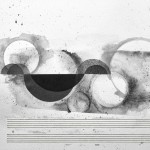


Cornelius Cardew’s Treatise is a work that has seduced musicians for decades, not because it tells them what to do, but because it stubbornly refuses to. A 193-page score without a single conventional note, just cryptic geometries and a long central line that seems to whisper: “here’s the axis of your universe, good luck”, To enter it is like reading a book where the words are erased but the punctuation remains, forcing you to invent the story with each turn of the page.
Larum - Micah Frank (modular synth), Chet Doxas (woodwinds, foley), and Taylor Deupree (looping, processing) - take Cardew’s challenge seriously, and perhaps mischievously. Their Treatise is not a free-for-all, but a kind of architectural spelunking: the line is treated as time itself, a horizon against which shapes become signs for harmony, density, or sudden silence. It’s almost as if Kandinsky were dictating music from beyond the grave, through diagrams rather than dictums.
The performances, recorded both at Public Records and at Fridman Gallery in New York, breathe differently depending on the room. In Brooklyn, the trio leans into warmth and pulse, with the modular synth pulsing like a nervous system while the woodwinds breathe a fragile human counterpoint. At the gallery, the music becomes more spectral, stretched like thin threads of spider silk, with silence taking on the weight of an instrument.
There are no lyrics, of course, but Doxas’s reed-playing often feels like a secret language trying to claw its way out of abstraction. The modular swells and loops frame it like parentheses around an unfinished sentence. If Treatise is a text, this version reads like poetry scrawled in disappearing ink - phrases half-heard, immediately dissolving into noise, only to be resurrected in another form minutes later.
It’s tempting to say Larum play Cardew, but that misses the point: they inhabit him, walk through his shapes like rooms, and leave their fingerprints on the walls. The result is music that is both rigorous and free, logic wrapped in intuition. And maybe that’s the joke: in order to play Treatise faithfully, you must betray it just enough to make it your own.
This Premier Rapport with Cardew’s ghost is not about resolution, but about conversation across time: a British radical drawing lines on paper in the 1960s, and a trio in 2025 turning those lines into something you can actually hear. It’s not an explanation - it’s a continuation.
Larum - Micah Frank (modular synth), Chet Doxas (woodwinds, foley), and Taylor Deupree (looping, processing) - take Cardew’s challenge seriously, and perhaps mischievously. Their Treatise is not a free-for-all, but a kind of architectural spelunking: the line is treated as time itself, a horizon against which shapes become signs for harmony, density, or sudden silence. It’s almost as if Kandinsky were dictating music from beyond the grave, through diagrams rather than dictums.
The performances, recorded both at Public Records and at Fridman Gallery in New York, breathe differently depending on the room. In Brooklyn, the trio leans into warmth and pulse, with the modular synth pulsing like a nervous system while the woodwinds breathe a fragile human counterpoint. At the gallery, the music becomes more spectral, stretched like thin threads of spider silk, with silence taking on the weight of an instrument.
There are no lyrics, of course, but Doxas’s reed-playing often feels like a secret language trying to claw its way out of abstraction. The modular swells and loops frame it like parentheses around an unfinished sentence. If Treatise is a text, this version reads like poetry scrawled in disappearing ink - phrases half-heard, immediately dissolving into noise, only to be resurrected in another form minutes later.
It’s tempting to say Larum play Cardew, but that misses the point: they inhabit him, walk through his shapes like rooms, and leave their fingerprints on the walls. The result is music that is both rigorous and free, logic wrapped in intuition. And maybe that’s the joke: in order to play Treatise faithfully, you must betray it just enough to make it your own.
This Premier Rapport with Cardew’s ghost is not about resolution, but about conversation across time: a British radical drawing lines on paper in the 1960s, and a trio in 2025 turning those lines into something you can actually hear. It’s not an explanation - it’s a continuation.
Comments
Stream
Browse by Genre
Industrial Music / Industrial Metal / Aggro Industrial / Electro Metal
Industrial Noise / Power Noise / Harsh Noise
Synth Pop / Electro Pop / Synth-Electronica
Techno / Trance / Goa / Drum'n'Bass / Jungle / Tribal / Trip-Hop
Ambient / Electronica / Ethereal / Dub / Soundscapes / Abstract
Experimental / Avantgarde / Weird & Wired / Glitch / Noise / Field Recording
Dark / Gothic / Wave / New Wave / Dark Wave / Industrial Gothic
New Music / Downtown / Avantgarde Jazz / New Classical / World