
Friday, September 4, 2026
Matthias Kaiser & Reinhold Friedl: ololuge
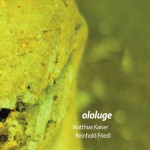
Artist: Matthias Kaiser & Reinhold Friedl (@)
Title: ololuge
Format: CD + Download
Label: tonkunstmanufaktur (@)
Rated:


Title: ololuge
Format: CD + Download
Label: tonkunstmanufaktur (@)
Rated:
There is music that comforts, and there is music that confronts. Then there is "ololuge", which neither strokes your hair nor slaps your face, but perhaps sits beside you and sobs in strange, ancestral tongues. A collaboration between violinist Matthias Kaiser and pianist Reinhold Friedl (yes, the very Friedl known for playing his piano from the inside out, like a magician spelunking through sound), "ololuge" resurrects the idea of lament not as genre or gesture, but as geological event.
Titled after the ancient Greek word for “ululation” - that trembling, ecstatic cry shared by weddings and funerals across cultures - this record unfurls in four parts: "lamento", "howl", "moan", and "whimper". The names read like a timeline of human collapse or an overdramatized breakup. But don’t be fooled - this is not mere melodrama. It’s an excavation of the emotional spectrum that exists just beyond the reach of language, using violin and piano as tools for audible excavation.
Kaiser, whose background in extended violin techniques and improvisation places him on the esoteric edges of string theory (both musical and perhaps quantum), doesn’t simply play the violin. He invokes it. The instrument, usually consigned in contemporary experimental music to a life of pointillist plinks and microtonal dry heaves, is here allowed to stretch, to sob, to scream. It’s romantic, yes, but not in the chocolate-and-roses sense - more in the Heathcliff-on-the-moors, ghost-on-the-wind, my-soul-is-a-tattered-curtain register.
Friedl’s piano - or rather, his "inside piano" - doesn’t so much accompany the violin as it stalks it, rattles it, shelters it, chides it. One moment he is scraping whispers from the strings like frost from glass; the next, conjuring subterranean tremors that feel more geological than musical. Friedl's command of the instrument is by now legend, and here he proves yet again that a grand piano contains multitudes - at least one of them being an entire-haunted shipwreck.
"ololuge" might recall the ghost cries of Giacinto Scelsi, the string wranglings of Hélène Breschand or John Zorn’s chamber horror, but it's not a pastiche of avant-garde gestures. It is, rather, a deeply lived ritual. The recording (from Duke’s Studio, Berlin) captures the textures with aching clarity: wood groaning, strings sweating, silence breathing between gestures. Nothing is polished, yet nothing feels accidental. You don’t listen to this record - you eavesdrop on it.
And yet, for all its anguish and murmur, "ololuge" is not dour. There’s a strange, wry wit at play. The record opens with "lamento", barely three minutes long - a compressed sigh before the deluge. "Howl", the second track, stretches to seventeen minutes, a bold middle finger to anyone who thought experimental music had to be polite or brief. And "whimper", ironically, closes the album not with a whimper but with a patient, gnawing persistence, like grief that refuses to pack its bags and go.
So, is "ololuge" beautiful? Yes - in the way ancient ruins are beautiful, or a language no one speaks anymore. It’s the sound of emotional memory scraping itself back into shape. It’s the kind of music you don’t hum along to, but which hums along your spine for days.
Recommended listening: alone, in the fog, while contemplating how many vowels a scream can carry.
Titled after the ancient Greek word for “ululation” - that trembling, ecstatic cry shared by weddings and funerals across cultures - this record unfurls in four parts: "lamento", "howl", "moan", and "whimper". The names read like a timeline of human collapse or an overdramatized breakup. But don’t be fooled - this is not mere melodrama. It’s an excavation of the emotional spectrum that exists just beyond the reach of language, using violin and piano as tools for audible excavation.
Kaiser, whose background in extended violin techniques and improvisation places him on the esoteric edges of string theory (both musical and perhaps quantum), doesn’t simply play the violin. He invokes it. The instrument, usually consigned in contemporary experimental music to a life of pointillist plinks and microtonal dry heaves, is here allowed to stretch, to sob, to scream. It’s romantic, yes, but not in the chocolate-and-roses sense - more in the Heathcliff-on-the-moors, ghost-on-the-wind, my-soul-is-a-tattered-curtain register.
Friedl’s piano - or rather, his "inside piano" - doesn’t so much accompany the violin as it stalks it, rattles it, shelters it, chides it. One moment he is scraping whispers from the strings like frost from glass; the next, conjuring subterranean tremors that feel more geological than musical. Friedl's command of the instrument is by now legend, and here he proves yet again that a grand piano contains multitudes - at least one of them being an entire-haunted shipwreck.
"ololuge" might recall the ghost cries of Giacinto Scelsi, the string wranglings of Hélène Breschand or John Zorn’s chamber horror, but it's not a pastiche of avant-garde gestures. It is, rather, a deeply lived ritual. The recording (from Duke’s Studio, Berlin) captures the textures with aching clarity: wood groaning, strings sweating, silence breathing between gestures. Nothing is polished, yet nothing feels accidental. You don’t listen to this record - you eavesdrop on it.
And yet, for all its anguish and murmur, "ololuge" is not dour. There’s a strange, wry wit at play. The record opens with "lamento", barely three minutes long - a compressed sigh before the deluge. "Howl", the second track, stretches to seventeen minutes, a bold middle finger to anyone who thought experimental music had to be polite or brief. And "whimper", ironically, closes the album not with a whimper but with a patient, gnawing persistence, like grief that refuses to pack its bags and go.
So, is "ololuge" beautiful? Yes - in the way ancient ruins are beautiful, or a language no one speaks anymore. It’s the sound of emotional memory scraping itself back into shape. It’s the kind of music you don’t hum along to, but which hums along your spine for days.
Recommended listening: alone, in the fog, while contemplating how many vowels a scream can carry.
Comments
Stream
Browse by Genre
Industrial Music / Industrial Metal / Aggro Industrial / Electro Metal
Industrial Noise / Power Noise / Harsh Noise
Synth Pop / Electro Pop / Synth-Electronica
Techno / Trance / Goa / Drum'n'Bass / Jungle / Tribal / Trip-Hop
Ambient / Electronica / Ethereal / Dub / Soundscapes / Abstract
Experimental / Avantgarde / Weird & Wired / Glitch / Noise / Field Recording
Dark / Gothic / Wave / New Wave / Dark Wave / Industrial Gothic
New Music / Downtown / Avantgarde Jazz / New Classical / World