
Mario Verandi: Face Against Sky
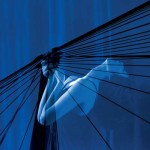


Mario Verandi’s "Face Against Sky" is an album that drifts between the tangible and the ethereal, a collection of sonic mirages where electronic textures meet the breath of ancient woodwinds and ghostly voices. Like gazing at the sky until shapes emerge from clouds, the album invites the listener into a space where structure and abstraction coexist, where the rigor of composition dissolves into open-ended improvisation.
Verandi, an Argentinian-born composer based in Berlin, has long navigated the intersections of electronic and electroacoustic music, contemporary classical experimentation, and environmental soundscapes. His previous album "Remansum" (2020) marked a shift in his approach, integrating instrumentalists into his world of digitally sculpted atmospheres. "Face Against Sky" continues this trajectory but leans further into rhythmic structures and a more overtly electronic character. It feels like a landscape shaped by invisible winds - natural yet manipulated, intuitive yet meticulously constructed.
The presence of Franziska Salker’s recorders (bass, Helder tenor, and Paetzold double bass) adds a strikingly organic dimension to the album. These aren’t medieval flutes or baroque ornaments but resonant, breathy voices that merge seamlessly with Verandi’s analog synthesizers and manipulated field recordings. There’s something almost ritualistic about the way these sounds interact, evoking both the sacred austerity of early music and the experimental openness of artists like Jan Bang, Fennesz, or Oren Ambarchi. In "Sky Once Blue", the album’s most haunting moment, the wordless vocals of Johanna Klein replace a once-planned piano line, her voice floating through the mix like a memory that refuses to fade.
Rhythm plays a larger role here than in "Remansum", but always with restraint. In tracks like "Janus" and "Motionshine", pulses emerge like distant signals, circling rather than driving forward. There are echoes of early ambient techno, but instead of momentum, the focus is on texture, on the subtle tension between stillness and movement. "Moons Falling" and "Odd Lips Walking" take this even further, their structures bending like light refracting through shifting layers of air.
The title track, "Face Against Sky", feels like the album’s emotional core - a slow, unfolding piece where all elements converge, a moment of suspended weightlessness where electronic manipulations and acoustic breathwork dissolve into one another. Verandi doesn’t impose grand gestures; instead, he crafts an environment where details reveal themselves slowly, where each note feels like a part of something larger, something unseen yet undeniably present.
Much like the cover photograph by Corinna Rosteck, where reflections blur the boundary between sky and surface, "Face Against Sky" exists in a liminal space. It is a deeply textural, evocative work - one that doesn’t demand attention but rewards deep listening with its shifting layers of meaning and feeling. It stands as both an evolution of Verandi’s methods and a reminder of how the physical and the ephemeral, the composed and the spontaneous, can dissolve into something uniquely immersive.
Verandi, an Argentinian-born composer based in Berlin, has long navigated the intersections of electronic and electroacoustic music, contemporary classical experimentation, and environmental soundscapes. His previous album "Remansum" (2020) marked a shift in his approach, integrating instrumentalists into his world of digitally sculpted atmospheres. "Face Against Sky" continues this trajectory but leans further into rhythmic structures and a more overtly electronic character. It feels like a landscape shaped by invisible winds - natural yet manipulated, intuitive yet meticulously constructed.
The presence of Franziska Salker’s recorders (bass, Helder tenor, and Paetzold double bass) adds a strikingly organic dimension to the album. These aren’t medieval flutes or baroque ornaments but resonant, breathy voices that merge seamlessly with Verandi’s analog synthesizers and manipulated field recordings. There’s something almost ritualistic about the way these sounds interact, evoking both the sacred austerity of early music and the experimental openness of artists like Jan Bang, Fennesz, or Oren Ambarchi. In "Sky Once Blue", the album’s most haunting moment, the wordless vocals of Johanna Klein replace a once-planned piano line, her voice floating through the mix like a memory that refuses to fade.
Rhythm plays a larger role here than in "Remansum", but always with restraint. In tracks like "Janus" and "Motionshine", pulses emerge like distant signals, circling rather than driving forward. There are echoes of early ambient techno, but instead of momentum, the focus is on texture, on the subtle tension between stillness and movement. "Moons Falling" and "Odd Lips Walking" take this even further, their structures bending like light refracting through shifting layers of air.
The title track, "Face Against Sky", feels like the album’s emotional core - a slow, unfolding piece where all elements converge, a moment of suspended weightlessness where electronic manipulations and acoustic breathwork dissolve into one another. Verandi doesn’t impose grand gestures; instead, he crafts an environment where details reveal themselves slowly, where each note feels like a part of something larger, something unseen yet undeniably present.
Much like the cover photograph by Corinna Rosteck, where reflections blur the boundary between sky and surface, "Face Against Sky" exists in a liminal space. It is a deeply textural, evocative work - one that doesn’t demand attention but rewards deep listening with its shifting layers of meaning and feeling. It stands as both an evolution of Verandi’s methods and a reminder of how the physical and the ephemeral, the composed and the spontaneous, can dissolve into something uniquely immersive.
Comments
Stream
Browse by Genre
Industrial Music / Industrial Metal / Aggro Industrial / Electro Metal
Industrial Noise / Power Noise / Harsh Noise
Synth Pop / Electro Pop / Synth-Electronica
Techno / Trance / Goa / Drum'n'Bass / Jungle / Tribal / Trip-Hop
Ambient / Electronica / Ethereal / Dub / Soundscapes / Abstract
Experimental / Avantgarde / Weird & Wired / Glitch / Noise / Field Recording
Dark / Gothic / Wave / New Wave / Dark Wave / Industrial Gothic
New Music / Downtown / Avantgarde Jazz / New Classical / World