
Christof Migone: Auditorium (Chaos, Quiet, Fail)
Artist: Christof Migone (@)
Title: Auditorium (Chaos, Quiet, Fail)
Format: CD
Label: The Dim Coast
Rated:


Title: Auditorium (Chaos, Quiet, Fail)
Format: CD
Label: The Dim Coast
Rated:
Imagine you’re at an art installation, but instead of admiring what’s on the wall, you’re there to listen to someone failing spectacularly at an audio piece. It’s less a concert and more an existential exercise in "not" listening while listening. That’s what Christof Migone’s "Auditorium (Chaos, Quiet, Fail)" feels like: a meticulous, controlled, and possibly absurd exploration of the sound of silence, failure, and collective confusion. It’s like being invited to a dinner party where no one says anything, yet you can’t stop hearing everything.
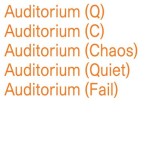
The album begins with “Auditorium (Q)”, a nearly 15-minute meditation that’s more about the anticipation of sound than sound itself. We’re plunged into a space that feels haunted by echoes of past failures, but the real genius lies in the fact that "nothing much happens". There’s a kind of Cagean brilliance in this — a modern nod to “I have nothing to say, and I am saying it”, except here, you’re waiting for that moment when Migone finally delivers... but instead, you hear the squeak of a chair, the subtle rustle of a shirt sleeve, or maybe someone exhaling loudly because they’re also wondering, “Is this it?”.
It’s the sound of "audience" rather than "performance". Migone takes the concept of ambient noise and runs with it - no, sprints with it - until it’s an art form all its own. It’s like being trapped inside a John Cage symposium where everyone forgot to play the instruments, and all that’s left is the rustling of programs.
The second track, “Auditorium (C)”, builds on this concept of tension and release, but here’s where it gets more chaotic. You start to hear the bodies in the room as much as the room itself. Is that laughter? Is someone burping? Or maybe it’s a collective sigh of relief that we’re finally getting some human noise amidst the void. What Migone captures here is "the performance of being present" — a shared experience where the people in the room are both performers and audience members, and we, the distant listeners, are invited to voyeuristically listen to them listen.
As for “Auditorium (Chaos)”, this is where the train fully derails - but in the most delightful way possible. If “Quiet” was about subtlety, “Chaos” is the loud, unruly sibling that knocks over your drink at a family reunion. People are talking, instruments are being played seemingly at random, and there’s a sense of gleeful disorder that’s infectious. It’s the sound of people giving up on decorum and just enjoying the act of making noise, whether it was intended. The best part? None of this was supposed to happen. It’s like Migone set the stage for high art and instead got a soundscape of wine-fueled improvisation.
But let’s talk about the pièce de résistance: “Auditorium (Fail)”. The original failed piece, a sonic artifact that Migone consciously sabotaged, is the heart of this project. It’s here, wrapped in layers of irony and intention, that we get to experience the failure that was never meant to be heard. It’s both fascinating and, well, a little frustrating. This track embodies the ultimate anti-climax: the sound of someone trying to create something profound and deciding, halfway through, to let it rot. There’s something both endearing and exasperating about this. It's like Migone is saying, “Here’s my failure. Enjoy it”, and you kind of "do", because the absurdity is captivating.
Yet beneath all this irony and conceptual play, there’s something deeply emotional in "Auditorium (Chaos, Quiet, Fail)". The idea of listening to others listen—of being present in their presence without ever being there—taps into something human. It’s an exploration of shared experience, of collective vulnerability, and ultimately, of failure as a form of art. Migone succeeds where he wanted to fail, and in doing so, he draws us into a sonic world where the boundaries between success and failure blur.
Fans of sound art will find this album a masterclass in conceptual audio. For those who want a tune, a melody, or even a hint of rhythm, look elsewhere. This is music at its most abstract, a refusal of form and an embrace of everything left in its wake. It’s not about what’s played; it’s about what’s not played, what’s barely heard, and what we imagine in the gaps. It’s Cage’s ghost laughing somewhere in the background, while the rest of us sit in uncomfortable silence.
The album begins with “Auditorium (Q)”, a nearly 15-minute meditation that’s more about the anticipation of sound than sound itself. We’re plunged into a space that feels haunted by echoes of past failures, but the real genius lies in the fact that "nothing much happens". There’s a kind of Cagean brilliance in this — a modern nod to “I have nothing to say, and I am saying it”, except here, you’re waiting for that moment when Migone finally delivers... but instead, you hear the squeak of a chair, the subtle rustle of a shirt sleeve, or maybe someone exhaling loudly because they’re also wondering, “Is this it?”.
It’s the sound of "audience" rather than "performance". Migone takes the concept of ambient noise and runs with it - no, sprints with it - until it’s an art form all its own. It’s like being trapped inside a John Cage symposium where everyone forgot to play the instruments, and all that’s left is the rustling of programs.
The second track, “Auditorium (C)”, builds on this concept of tension and release, but here’s where it gets more chaotic. You start to hear the bodies in the room as much as the room itself. Is that laughter? Is someone burping? Or maybe it’s a collective sigh of relief that we’re finally getting some human noise amidst the void. What Migone captures here is "the performance of being present" — a shared experience where the people in the room are both performers and audience members, and we, the distant listeners, are invited to voyeuristically listen to them listen.
As for “Auditorium (Chaos)”, this is where the train fully derails - but in the most delightful way possible. If “Quiet” was about subtlety, “Chaos” is the loud, unruly sibling that knocks over your drink at a family reunion. People are talking, instruments are being played seemingly at random, and there’s a sense of gleeful disorder that’s infectious. It’s the sound of people giving up on decorum and just enjoying the act of making noise, whether it was intended. The best part? None of this was supposed to happen. It’s like Migone set the stage for high art and instead got a soundscape of wine-fueled improvisation.
But let’s talk about the pièce de résistance: “Auditorium (Fail)”. The original failed piece, a sonic artifact that Migone consciously sabotaged, is the heart of this project. It’s here, wrapped in layers of irony and intention, that we get to experience the failure that was never meant to be heard. It’s both fascinating and, well, a little frustrating. This track embodies the ultimate anti-climax: the sound of someone trying to create something profound and deciding, halfway through, to let it rot. There’s something both endearing and exasperating about this. It's like Migone is saying, “Here’s my failure. Enjoy it”, and you kind of "do", because the absurdity is captivating.
Yet beneath all this irony and conceptual play, there’s something deeply emotional in "Auditorium (Chaos, Quiet, Fail)". The idea of listening to others listen—of being present in their presence without ever being there—taps into something human. It’s an exploration of shared experience, of collective vulnerability, and ultimately, of failure as a form of art. Migone succeeds where he wanted to fail, and in doing so, he draws us into a sonic world where the boundaries between success and failure blur.
Fans of sound art will find this album a masterclass in conceptual audio. For those who want a tune, a melody, or even a hint of rhythm, look elsewhere. This is music at its most abstract, a refusal of form and an embrace of everything left in its wake. It’s not about what’s played; it’s about what’s not played, what’s barely heard, and what we imagine in the gaps. It’s Cage’s ghost laughing somewhere in the background, while the rest of us sit in uncomfortable silence.
Comments
Stream
Browse by Genre
Industrial Music / Industrial Metal / Aggro Industrial / Electro Metal
Industrial Noise / Power Noise / Harsh Noise
Synth Pop / Electro Pop / Synth-Electronica
Techno / Trance / Goa / Drum'n'Bass / Jungle / Tribal / Trip-Hop
Ambient / Electronica / Ethereal / Dub / Soundscapes / Abstract
Experimental / Avantgarde / Weird & Wired / Glitch / Noise / Field Recording
Dark / Gothic / Wave / New Wave / Dark Wave / Industrial Gothic
New Music / Downtown / Avantgarde Jazz / New Classical / World