
Wednesday, November 4, 2026
Browse by Genre
Industrial Music / Industrial Metal / Aggro Industrial / Electro Metal
Industrial Noise / Power Noise / Harsh Noise
Synth Pop / Electro Pop / Synth-Electronica
Techno / Trance / Goa / Drum'n'Bass / Jungle / Tribal / Trip-Hop
Ambient / Electronica / Ethereal / Dub / Soundscapes / Abstract
Experimental / Avantgarde / Weird & Wired / Glitch / Noise / Field Recording
Dark / Gothic / Wave / New Wave / Dark Wave / Industrial Gothic
New Music / Downtown / Avantgarde Jazz / New Classical / World
Search Reviews
Music Reviews
Superføkk!: s/t

Artist: Superføkk! (@)
Title: s/t
Format: Download Only (MP3 + Lossless)
Label: Fysisk Format (@)
Rated:

Title: s/t
Format: Download Only (MP3 + Lossless)
Label: Fysisk Format (@)
Rated:
There are bands that spend years trying to find their sound, and then there are bands that seem to have decided, almost immediately, that finding one would be a rather restrictive use of their time. Superføkk! belong firmly to the latter category. Their self-titled debut is a compact demonstration of musical restlessness, a three-track collision between free jazz, no-wave, noise rock, krautrock, electronics and whatever else happens to be within reach when the instruments start misbehaving. It is energetic, abrasive, frequently funny in its sheer disregard for decorum, and considerably more disciplined than its apparent lack of discipline might suggest.
The Norwegian quartet emerged in Bergen in autumn 2024, initially taking shape in a small studio at the Bergen Kjøtt cultural centre. The lineup brings together Victor Skullerud on drums, Eik Stavem on electric bass, Ole-Hellik Lobben-Seth on guitar and synthesizer, and August Ramstad on tenor and baritone saxophones, electronics and percussion. Within a remarkably short time, they developed a substantial live repertoire, played extensively around Bergen and won the 2025 Eggstock Festival, also receiving recognition from the Vill Vill Vest festival. Their debut was recorded at Duper Studio in November 2025, with Jørgen Træen responsible for mixing and mastering, Iver Sandøy producing, and artwork by Aksel Thorbjørnsen.
The band's name is unlikely to be mistaken for a delicate invitation to afternoon tea. In Norwegian, it carries a suitably irreverent punch, and the music follows through on the promise. Yet Superføkk! are not simply interested in making a racket for the pleasure of watching musical furniture collapse. Their approach is more curious than that: they take recognisable elements from different traditions and subject them to abrupt changes of direction, sudden accelerations and unexpected encounters. The result has something of the nervous intelligence of Black Midi, the rhythmic sophistication associated with Jaga Jazzist, the confrontational attitude of James Chance and the angular theatricality of no-wave. These comparisons provide useful coordinates, but the quartet's identity is less about assembling a convincing family tree than about making the branches collide.
The album's three compositions occupy almost exactly half an hour, which is enough time for the group to establish its methods without allowing the exercise to become an endurance test. "Grønn" opens proceedings with a restless interplay between saxophone, guitar and rhythm section. Rather than establishing a groove and then decorating it, the musicians seem to negotiate the rhythmic ground in real time, with accents appearing and disappearing as the instruments exchange ideas. The saxophone brings a sharp, sometimes almost abrasive melodic presence, while the guitar moves between jagged riffing and more fragmented gestures. Skullerud's drumming and Stavem's bass provide the necessary propulsion, although the rhythm never feels like a fixed platform. It behaves more like a moving target.
There is a distinctly physical quality to this music. Even when the arrangements become intricate, the quartet avoids the impression of musicians demonstrating their technical abilities to an imaginary examination board. The playing is tight, but it retains the nervous energy of something liable to go off course at any moment. That tension is central to the album's appeal. Superføkk! can sound almost danceable, then suddenly pull the floor away from beneath the listener's feet. The body is encouraged to move; the brain is advised not to become too attached to any particular time signature.
At twelve minutes, "River Igjennom" provides the album's most substantial opportunity for the group to explore its shifting dynamics. The longer duration allows ideas to develop, mutate and occasionally undermine themselves. The interplay between the saxophones and guitar becomes especially important here, with the electronic elements adding further instability to the ensemble's sound. The music moves through passages of concentrated rhythmic activity and more open, exploratory exchanges, avoiding the conventional progression from quiet introduction to explosive climax. Instead, its energy seems to circulate, gathering intensity and then redirecting it elsewhere. The result is less a journey with a clearly marked destination than a series of diversions undertaken by four people who have collectively misplaced the map and decided that this is probably an improvement.
The title "River Igjennom" suggests movement through something, and the composition has an appropriately fluid character, although its flow is anything but smooth. The musicians continually disturb the surface, producing a mixture of muscular rock energy and improvisational freedom. There are moments when the group approaches the jagged precision of experimental math rock, only to veer towards the more unruly territory of free jazz. The synthesizer and electronics prevent the music from settling into a purely instrumental rock format, while the saxophone avoids becoming a conventional jazz lead instrument. Every component seems willing to change its function whenever the opportunity arises.
"Piggeple" closes the record with another extended burst of activity, and it is arguably the track that brings the band's various tendencies into the sharpest focus. Its combination of driving rhythm, noisy textures and saxophone-led intensity creates an exhilarating sense of collective momentum. There is a strong punk sensibility beneath the musical complexity: not necessarily in the form of familiar chord structures or straightforward aggression, but in the conviction that music should be allowed to sound excessive, awkward and alive. The composition's energy is cathartic without becoming simplistic, and its danceable qualities are particularly striking. This is music that could easily turn a crowded room into a rather unconventional exercise in cardiovascular health.
The production deserves credit for preserving the rawness of the performances without allowing the individual instruments to disappear into a single indistinct mass. Jørgen Træen's work gives the record enough definition to make its rhythmic exchanges and instrumental details audible, while retaining the rough edges that are essential to the group's character. The three compositions also benefit from their contrasting proportions and internal development. There is no sense of a band padding out a debut with interchangeable material; each piece has a distinct role in the overall sequence, and the album's brevity makes its intensity all the more effective.
What makes Superføkk! particularly interesting is that their genre-hopping does not feel like an attempt to collect fashionable reference points. Free improvisation, krautrock, no-wave, jazz-rock and electronic experimentation are not presented as separate ingredients waiting to be mixed according to a recipe. They are treated as different ways of approaching rhythm, texture and collective interaction. The quartet's music is therefore eclectic without being indiscriminate. Its unpredictability comes from the way the musicians respond to one another, not from a desperate need to introduce a new stylistic surprise every thirty seconds.
There is also something refreshing about the decision to make a debut consisting of just three substantial pieces. In an era when albums can sometimes resemble playlists assembled by an indecisive committee, Superføkk! offer a coherent statement without insisting on unnecessary duration. The title is appropriately self-contained, too: no elaborate conceptual apparatus, no grandiose mythology, just the band's name and a record that gets on with the business of being itself.
Superføkk! are still a young group, and this first album captures the particular excitement of musicians discovering how far they can push a shared language. Its roughness is not a defect to be apologised for, but neither is it an excuse for careless playing. Beneath the racket there is considerable attention to detail, and beneath the technical dexterity there is a direct, almost mischievous desire to make people move. The quartet may not be especially interested in conventional genre boundaries, but they clearly understand the value of a good physical reaction. Sometimes the most persuasive argument for musical freedom is not a manifesto or a carefully constructed theoretical position. It is four musicians making an almighty noise, finding a groove where none was supposed to exist, and daring the audience to stand still.
Honey Ride Me A Goat: Horns & Hooves
Artist: Honey Ride Me A Goat
Title: Horns & Hooves
Format: 12" + Download
Label: Cuneiform (http://www.cuneiformrecords.com/) (@)
Rated:

Title: Horns & Hooves
Format: 12" + Download
Label: Cuneiform (http://www.cuneiformrecords.com/) (@)
Rated:
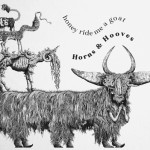
Honey Ride Me A Goat have never seemed particularly concerned with making music that behaves itself. Their name sounds like the result of a pub conversation that went badly wrong, and their compositions tend to share that conversation's disregard for conventional manners. Yet there is more to this Kentish trio's peculiar universe than a taste for absurdity and instrumental demolition. "Horns & Hooves", their first full-length album for Cuneiform Records, finds them refining an approach built around the friction between tightly organised structures and spontaneous disruption. The addition of American saxophonist Patrick Shiroishi makes that friction even more productive, giving the band's familiar guitar-bass-drums combination a new dimension without turning it into a conventional jazz-rock outfit.
The history behind the record is a little unusual. Honey Ride Me A Goat were formed by school friends attending college in Canterbury in the early 2000s, united by a shared affection for Captain Beefheart, Black Sabbath and Soft Machine. They began playing live around 2005, releasing a self-titled EP in 2006, followed by a series of tapes and split releases. Much of this early material was gathered on "Udders", issued by Australia's Lexicon Devil in 2010. Their association with Canterbury's musical heritage became more concrete when they recorded an improvised session with Soft Machine bassist Hugh Hopper in 2008. The resulting material eventually appeared as "Goat Hopper" in 2013, after Hopper's death in 2009 had put an end to plans for further collaboration. The band continued to work with American avant-rock group Upsilon Acrux, including joint UK tours and a split release, before eventually entering a lengthy hiatus in 2020.
The new album was recorded in early 2020 and subsequently left unreleased for several years before finding its home at Cuneiform. This delayed arrival gives "Horns & Hooves" the slightly peculiar status of a document from a band that had already moved into a different chapter of its existence by the time the record reached listeners. It also captures a significant change in their sound. The earlier material was often characterised by furious, tightly packed jazz-punk, but here the group allows more direct compositional forms to develop, creating additional room for improvisation. The presence of Shiroishi is central to this evolution. Rather than being invited to provide occasional saxophone decoration, he becomes an integral part of the arrangements, contributing to the music's architecture as well as its more unrestrained passages.
Shiroishi is an especially appropriate collaborator. The Los Angeles-based saxophonist has developed an extensive body of work across free improvisation, experimental music, noise and punk, both as a solo artist and through numerous collaborations. His playing can move between abrasive blasts, lyrical phrases and extended textural explorations, and he has a particularly useful ability to inhabit music without simply taking it over. His experience with Upsilon Acrux also provides a direct link to HRMAG's own history. On "Horns & Hooves", the saxophone does not function as a guest soloist perched above the rhythm section; it becomes another unruly participant in the band's collective argument.
The album opens with "Meatpecker Suite", an eight-minute introduction to the quartet's peculiar sense of order. A jagged guitar figure establishes an angular framework, quickly joined by bass and drums, before the saxophone begins to complicate the arrangement. The music moves between clipped, repeated motifs and freer exchanges, with the instruments repeatedly threatening to pull the piece in different directions. There is a pleasingly physical quality to the performance, but the musicians are not simply chasing speed or volume. Their rhythmic interplay is too considered for that. Even when the arrangement becomes chaotic, one can sense the underlying framework holding everything together, like the structural beams of a building that has been designed by someone with a serious disagreement with right angles.
"Gooseflaps" takes a more compact route, relying on abrupt changes and tightly wound rhythmic gestures. Its short duration makes it feel almost like a concentrated burst of nervous energy, with guitar and saxophone trading sharp-edged phrases over a rhythm section that refuses to settle into predictable patterns. There is a trace of no-wave's confrontational economy here, but also a playful quality that prevents the music from becoming merely aggressive. The title, naturally, offers little assistance in interpreting the composition. One suspects that this is entirely intentional.
"Spacedocker" is one of the album's most immediately engaging pieces, combining a more recognisable rhythmic drive with the quartet's fondness for sudden structural detours. The guitar provides a stronger sense of direction, while the saxophone adds a wiry, restless counterpoint. The piece has something of the muscular precision associated with math rock, but it avoids the genre's more familiar displays of instrumental athleticism. There is no obvious desire to demonstrate how many subdivisions can be squeezed into a bar before the listener requests medical assistance. Instead, the musicians use rhythmic complexity as a means of generating tension and movement. The result is energetic, oddly catchy and just unpredictable enough to keep the floorboards nervous.
"Collyleg" brings the first half of the record to a close with another compact exercise in controlled disruption. Its short form gives the band little opportunity to settle into a single idea, and the music seems to enjoy the resulting instability. Yet the quartet's ability to make these abrupt transitions feel natural is one of its most persuasive qualities. Their compositions are not simply collections of unrelated riffs and improvisations; there is a clear sense of interaction between the different elements, even when the direction changes without warning.
The remaining four pieces on the full digital edition broaden the picture considerably. "Preposterous Proboscis / Tephra" makes the band's Beefheart inheritance particularly apparent, combining an eccentric, almost cartoonish central motif with a more volatile instrumental conversation. The composition moves between playful rhythmic patterns and noisier passages, allowing its absurdity to become part of the musical structure rather than an amusing distraction. "Flambé Gump" pushes further towards the abrasive end of the spectrum, with guitar and saxophone generating a particularly unruly texture. The performance has a rough, almost confrontational energy, but it remains sufficiently alert to dynamics to avoid becoming an undifferentiated wall of sound.
Then comes "Plappy", a welcome change of temperature. Michael Pike's piano introduces a more lyrical dimension, and the composition's comparatively measured pace reveals a side of the band that might otherwise remain concealed beneath the rhythmic commotion. There is a slightly melancholic quality to the piece, and its more direct melodic gestures provide a useful contrast to the album's harsher passages. It is not exactly a ballad, unless one imagines a ballad being performed by musicians who have just discovered that the piano has been left unattended in a room full of strange noises. Still, its presence is important: it demonstrates that the group can create atmosphere and melodic focus without abandoning its distinctive character.
The closing "Bedlams Bottom" returns to more turbulent territory, with discordant guitar work and increasingly free rhythmic activity bringing the record to an appropriately unsettled conclusion. The title suggests a place where things have gone badly wrong, and the music offers little evidence to the contrary. Shiroishi's saxophone is particularly effective in this context, moving between sharply defined gestures and more open-ended bursts of sound. The final impression is not one of resolution, but of a group that has discovered several new ways to make its own musical machinery malfunction.
What distinguishes "Horns & Hooves" from a great deal of contemporary instrumental experimentation is its attitude towards complexity. The band is clearly capable of intricate playing, but it does not confuse technical difficulty with artistic purpose. Its rhythmic frameworks are often built through repetition rather than conventional notation, leaving room for the musicians to alter, extend or destabilise them in performance. This gives the music a flexibility that is different from the tightly scripted intricacies of much math rock. The compositions can be precise without feeling rigid, and improvised without becoming shapeless. That balance is not easy to achieve, particularly when the instruments involved seem to have been selected partly for their ability to disagree with one another.
The production helps preserve this tension. The recordings, made at Big Jelly Studios and Delta Studios, have a raw but clearly defined sound, allowing the instrumental details to remain audible even when the music becomes particularly dense. Guitar, bass and drums retain their physical weight, while the saxophone is given enough space to contribute meaningfully rather than simply decorate the arrangements. The result feels immediate without sacrificing the distinctions between the different musical voices.
There is also a welcome absence of solemnity. Experimental rock can sometimes become so preoccupied with demonstrating its seriousness that it forgets music is supposed to be an enjoyable activity. Honey Ride Me A Goat understand that absurdity and sophistication are not mutually exclusive. Their compositions can be demanding, dissonant and rhythmically intricate, but they also possess a mischievous streak that keeps the whole enterprise from becoming an academic exercise. The band's humour is not merely a matter of ridiculous titles; it is embedded in the way the music continually upsets expectations, as though the musicians are quietly amused by the listener's attempts to anticipate what comes next.
"Horns & Hooves" is therefore more than a belated document of a group with an unusually long and fragmented history. It captures a band finding a new balance between its original instincts and the possibilities offered by an expanded lineup. Patrick Shiroishi's contribution is substantial, but the underlying personality remains unmistakably that of HRMAG: angular, unpredictable, rhythmically mischievous and cheerfully resistant to categorisation. The album may have taken several years to reach the public, but its music sounds anything but archival. It has the restless energy of something that has been waiting patiently for the right moment to cause trouble.
Rhins: The Invisible

Artist: Rhins
Title: The Invisible
Format: Download Only (MP3 + Lossless)
Label: Dragon's Eye Recordings (@)
Rated:
Title: The Invisible
Format: Download Only (MP3 + Lossless)
Label: Dragon's Eye Recordings (@)
Rated:
Being misunderstood is exhausting. Being misunderstood repeatedly, while also having to explain why you are being misunderstood, can become an almost full-time occupation. J. Quimby’s "The Invisible", the latest release under the Rhins name, approaches this predicament without attempting to translate it into a reassuringly legible musical narrative. Instead, it makes a virtue of the very things that conventional communication tends to reject: repetition, overload, interruption, disorientation and the refusal to settle into a recognisable pattern. This is not ambient music designed to help the listener find their happy place. In fact, the happy place appears to have been evacuated, its furniture thrown out of the window and the windows themselves replaced with malfunctioning synthesizers.
The album was conceived during a period of upheaval, as Quimby was moving house and navigating other changes in life. That instability is reflected in the music's construction, but the significance of "The Invisible" reaches beyond the familiar association between personal turmoil and noisy electronics. Its central concern is the frustration of trying to communicate in a neurotypical world, where the expectations and conventions of interaction can make one's own experience difficult to express. Quimby describes the music as a form of communication in itself, one that does not depend on verbal explanation. The distinction is important: this is not simply an album about distress, nor is its intensity offered as a spectacle for curious outsiders. It is an attempt to establish a language on its own terms, even when that language is abrasive, fragmented or difficult to follow.
Rhins is the project of Scottish sound artist and composer J. Quimby, whose earlier releases have appeared through labels including Tombed Visions and Aurora Borealis. The new project also reconnects with a more aggressive musical past, particularly Quimby's involvement in Take A Worm For A Walk Week and Remember Remember, as well as the collaborative performance work with artist Iona Kewney under the Knights of the Invisible name. Those experiences help explain the unusual combination of force and ethereality found here. The music draws on the physical impact of noise and distortion, but also on the more delicate vocal and string-based sensibilities developed through theatrical and performance contexts. The result is not a compromise between two approaches so much as an attempt to make them coexist without smoothing away their differences. Quimby's previous Rhins release, "The Burnout", had already explored suffocating electronic textures; "The Invisible" pushes that vocabulary into a more personal and deliberately unstable territory.
The method is as significant as the subject. Rather than beginning with finished compositions and gradually dismantling them, Quimby starts from improvisation, allowing analogue synthesizers to develop into extended passages before subjecting the material to a process of destruction, subtraction and reconstruction. It is a compositional approach that resembles the repeated application and removal of paint, except that the canvas is sound and the paint occasionally appears to be industrial waste. The resulting pieces retain traces of their original gestures, but those gestures are buried beneath layers of distortion, overlapping tones and recurring patterns. What might initially seem chaotic gradually acquires an internal organisation. Not necessarily a comfortable one, admittedly, but comfort is hardly the album's principal concern.
"Iona" establishes the terms with considerable force. Thick, overlapping synthesizer tones accumulate into a dense mass, with distortion giving the sustained notes a rough, almost physical surface. There is a sense of something attempting to emerge through the pressure, although the music never provides a clean passage out. Its title gives the opening a personal dimension, particularly given the album's dedication to Iona Jane Kewney, whose artwork also accompanies the release. The connection between the dedication and the sound is not something that needs to be decoded; the piece is sufficiently affecting without turning into a puzzle about biography.
"Knights of the Invisible" introduces a different kind of presence. The additional vocals of Emily Quimby bring a human element into the electronic turbulence, but these are not conventional vocal performances in search of a melody or a lyrical message. The voice appears as texture, gesture and atmosphere, at times suggesting a ritual whose words have been deliberately withheld. A more discernible rhythmic movement eventually takes shape, giving the piece a sense of forward motion without making it any less uncanny. There are echoes of the slow-building dread associated with older horror cinema, particularly the synthetic unease of 1970s and 1980s soundtracks, but the music avoids becoming a nostalgic exercise in analogue spookiness. No haunted house has ever sounded quite so poorly equipped to deal with its own electrical system.
The subsequent "Black Regent" and "Self Interrupted" maintain the album's uneasy momentum. The former works through layered drones and shifting electronic pressure, allowing its darker textures to develop without resorting to obvious climactic gestures. The latter feels more abrupt and fractured, its title almost functioning as a description of the listening experience: just as one begins to follow a particular sonic direction, something intervenes. This is not accidental awkwardness. Interruption is part of the album's grammar, and the repeated disruption of expectation becomes one of its most effective compositional tools.
"Electric Woods" offers a more spacious environment, though its apparent openness should not be mistaken for tranquillity. The synth textures have a more enveloping quality, creating an atmosphere that is simultaneously inviting and suspicious. There is something almost organic in the way the layers develop, but the sense of nature suggested by the title is far removed from the pastoral conventions of ambient music. These woods are electrically charged, and the trees probably have a better grasp of circuit diagrams than the average visitor. "Spectrum Collectors", meanwhile, introduces more restless movement through repeating electronic figures and shifting layers. Its patterns seem to gather momentum, only to become absorbed into the surrounding density. The effect is less that of a conventional build-up than of an unstable system repeatedly trying to establish equilibrium.
The closing "Waiting for the Sea Eagle" is particularly revealing. Its softer passages and more open melodic contours suggest the possibility of release, perhaps even the calm that the album has repeatedly seemed to seek. Yet the tension does not disappear. As the piece develops, the more abrasive elements return, disrupting the apparent resolution. The title evokes an act of waiting, but the music offers no guarantee that the awaited arrival will make anything better. The sea eagle may be magnificent, but it is apparently running late.
Across these seven compositions, Quimby works with a strikingly physical understanding of electronic sound. The synthesizers are not merely instruments for creating atmospheric backgrounds; they become extensions of bodily and emotional gestures, repeating, swelling, colliding and withdrawing. The wordless voices are equally important. They suggest the presence of communication without submitting to the assumption that communication must always take the form of intelligible speech. This is where the album's relationship with neurodivergent experience becomes most meaningful. Its refusal to conform to conventional structures is not presented as a decorative aesthetic choice, but as part of a broader struggle over whose modes of expression are recognised and whose are routinely treated as inconvenient noise.
That said, "The Invisible" does not require the listener to approach it as a document or an explanatory statement. Its musical language has enough substance to withstand repeated listening independently of the context provided by the artist. Indeed, the album's most interesting quality is the tension between its raw origins and the considerable care involved in shaping the final result. The improvisations may begin without a predetermined architecture, but the reconstruction is anything but careless. Lawrence English's mastering preserves the density and force of the material while giving its overlapping layers a coherent presence. The music remains difficult, but it is not indiscriminate.
There is also something quietly radical in the decision to make an album whose title refers to invisibility and whose contents insist on being heard. The invisible is not necessarily absent; sometimes it is simply overlooked, misread or denied the space required to become perceptible. Quimby responds by turning that condition into sound, not by making it easier to consume, but by refusing to dilute its contradictions. "The Invisible" can be oppressive, disorienting and occasionally exhausting, yet its intensity is never empty. It gives form to an experience that resists easy explanation, and it does so without pretending that music can magically solve the problems of communication.
Perhaps that is the album's most affecting achievement. It does not ask to be understood through the usual channels, nor does it offer a reassuring conclusion in which all the noise eventually makes sense. It simply insists on its own presence. In a world that often mistakes unfamiliar expression for an absence of meaning, that insistence is worth hearing.
Ondness: I Can Only Put So Much Into a Song

Artist: Ondness (@)
Title: I Can Only Put So Much Into a Song
Format: Tape + Download
Label: Sucata Tapes (@)
Rated:
Title: I Can Only Put So Much Into a Song
Format: Tape + Download
Label: Sucata Tapes (@)
Rated:
There is a particular kind of nostalgia that has very little to do with wanting to return to the past. It is closer to remembering how it felt to encounter something for the first time, before familiarity made it manageable, before the things that once seemed impossibly vast became neatly filed away in the mental archive. Bruno Silva’s latest album as Ondness seems to inhabit precisely that peculiar territory. "I Can Only Put So Much Into a Song" looks back towards the music that helped shape his formative years, but it doesn't behave like a retrospective, a tribute compilation or an exercise in recreating some supposedly glorious period of independent music. Instead, it approaches memory as an unstable substance, something that can be stretched, distorted, submerged and occasionally mistaken for something else.
Silva is hardly a newcomer to the business of making sounds misbehave. The Lisbon-based musician has been active since the mid-2000s, developing a remarkably varied practice through Ondness, Serpente and several collaborative projects. While Serpente has often explored more physical, rhythmically adventurous territory, Ondness has provided a space for a different kind of electronic imagination, one interested in the transformation of samples, fragments, melodic suggestions and sonic debris into something that feels both familiar and strangely displaced. Silva is also involved in Portugal's musical infrastructure as a programmer and producer at Espaço das Damas, and his work has appeared on labels including Discrepant, Holuzam, Ecstatic and Where To Now?. His musical vocabulary has never been particularly keen on respecting borders, and this album finds him turning towards guitars without abandoning the electronic sensibility that has informed much of his previous output.
The references behind the record are unusually revealing. Iran's "The Moon Boys", The Microphones' "It Was Hot, We Stayed In The Water", Fennesz's "Endless Summer" and the sprawling, communal aesthetics of the New Weird America underground form a loose constellation around Silva's memories of adolescence and early adulthood. There is also a persistent black metal shadow, less a matter of genre imitation than a source of emotional pressure. These are not simply names dropped to establish the artist's alternative credentials, nor does the album sound like a checklist of influences assembled by someone who has spent too much time browsing old record collections. Rather, they suggest a period when guitar music, homemade experimentation, noise, folk, electronics and extreme music could coexist without anyone feeling obliged to explain the arrangement to a genre classification committee.
The opening "Tevens" immediately establishes the album's unsettled character. Guitar tones expand into thick, reverberant masses, while the vocal presence seems to emerge from somewhere behind the instrumental surface. There is a recognisable shoegaze ancestry in the way sound accumulates and obscures its own details, but the result is more shadowy than blissful. The guitars don't so much invite the listener to disappear into them as suggest that something might be waiting on the other side of the distortion. "Vento Gelo Valentine" deepens that impression, its heavy chords and ghostly vocal gestures carrying an almost ceremonial quality. The song feels as though it has been transmitted from a distant gathering whose participants have long since forgotten what they were celebrating.
One of the album's most appealing qualities is its refusal to let this atmosphere become monotonous. Silva understands that a dense sonic environment needs occasional openings, and he introduces them with a lightness that prevents the music from becoming trapped in its own fog. "Celesting" and "Blisser" provide different degrees of movement and melodic definition, the latter introducing a more clearly electronic pulse into the guitar-led material. Its small, nimble synth gestures don't dismantle the surrounding haze; they simply give it something to move around. There is a quiet pleasure in this juxtaposition, as if a modest piece of digital machinery had wandered into an overgrown garden and decided to stay.
The album's shorter pieces also contribute to its unusual sense of proportion. None of the nine tracks is especially long, and the entire record lasts just under half an hour. That brevity is significant. Rather than stretching its ideas into extended atmospheric exercises, Silva works with compact forms that feel like recollections surfacing briefly before slipping away again. The titles " (muito pouco)" and "(quase nada)", which translate roughly as 'very little' and 'almost nothing', seem to acknowledge the limits of what can be retained or communicated. They are small interruptions, but they also point towards the album's central concern: how much of an experience can actually survive its conversion into music? The answer, perhaps, is not very much. But the fragments that remain can be remarkably evocative.
"Glideness" offers another subtle shift in perspective, its textures moving between melodic suggestion and blurred abstraction. There is a looseness here that recalls the more exploratory corners of early-2000s independent music, when the distinction between a song, a recording experiment and an unfinished idea could be pleasantly difficult to establish. Silva does not attempt to polish away that uncertainty. His production allows sounds to retain their rough edges, while the mastering by Carlos Nascimento gives the material a coherent presence without sanding down its more unruly details. The result is intimate but not fragile, with distortion functioning less as an aggressive gesture than as a means of making the music feel physically close.
Then comes "Megadawn II", a title that inevitably invites comparison with Silva's earlier "Megadawn", released in 2022. Here, however, the electronic elements are not simply a continuation of the producer's previous experiments. They become part of the album's broader recollection of a musical past in which the supposedly incompatible could sit comfortably together. Beneath its celestial surface, the track contains a restless rhythmic undercurrent, a reminder that Silva's interest in electronic construction has not been suspended in favour of guitar nostalgia. The closing "Tevais" returns to the album's opening atmosphere, with another substantial wall of guitar sound and an elusive vocal presence. Its position creates a circular impression, although not quite the comforting symmetry of a journey completed. It is more like finding oneself back at a familiar location and discovering that the place has changed, or that one's memory of it was never entirely accurate.
The album's title comes from Farrah Abraham's "My Teenage Dream Ended", a record whose strange collision of celebrity confession, synthetic pop and emotional dislocation makes it an unexpectedly fitting reference point. It also introduces a wry little contradiction: Silva may claim that there is only so much he can put into a song, but the nine pieces here suggest that the limitations of the form are precisely what make it interesting. A song cannot preserve an entire adolescence, reconstruct every first encounter with music or settle the complicated business of becoming an adult. It can, however, hold a few distorted impressions, a half-remembered melody, a particular shade of melancholy or the sensation of hearing something that seems to belong simultaneously to yesterday and tomorrow.
That is where "I Can Only Put So Much Into a Song" finds its emotional weight. Its nostalgia is not particularly sentimental, and it avoids the familiar trap of treating youth as an irretrievable paradise populated exclusively by excellent records and questionable haircuts. The past is present here as a collection of imperfect impressions, some warm, others abrasive, all subject to the distortions of time. Silva's achievement is to make those impressions audible without turning them into a museum display. The music remains open-ended, occasionally opaque and quietly restless, allowing its influences to dissolve into a personal language rather than arranging them behind glass.
There is something touching about an album that accepts the inadequacy of songs while continuing to make them. Perhaps that is the whole point: music cannot contain everything, but it can preserve the outline of something that would otherwise disappear. And sometimes an outline, especially one drawn with this much distortion, says considerably more than a complete picture.
Russ Tolman: Stray
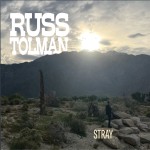
There is a particular kind of freedom that comes with getting older: the gradual realisation that one no longer has to impress anybody, follow the latest musical fashion or pretend that every disappointment was secretly a valuable learning experience. Russ Tolman's "Stray" operates from something close to this position. Its ten songs move through country, folk, rock, soul and Americana with the unhurried confidence of a songwriter who has spent decades learning what to keep and what to discard. There are no elaborate gestures towards reinvention, no desperate attempts to sound younger, and mercifully few signs of an artist checking the charts before deciding which guitar to pick up. Instead, Tolman offers a collection of compact, carefully arranged songs populated by imperfect characters, unresolved relationships and the occasional glimmer of hard-earned optimism. The album's title might suggest someone who has lost their way, but these songs sound more like the work of someone who has finally stopped asking for directions.
Tolman's musical history stretches back to the late seventies, when he formed Suspects with Steve Wynn and Kendra Smith, before founding True West in 1980. The latter became associated with the Paisley Underground, the loose Los Angeles scene that brought together psychedelic guitar music, jangling melodies and a healthy disregard for the boundaries between garage rock, folk and country. True West developed a darker, more hypnotic approach than some of their contemporaries, releasing two albums and touring extensively, including a stint opening for R.E.M. during the "Fables of the Reconstruction" tour. Tolman left the band in 1985 to pursue a solo career, beginning with "Totem Poles and Glory Holes" (1986). Subsequent records such as "Down In Earthquake Town", "Goodbye Joe", "Road Movie" and "Sweet Spot" established him as a songwriter with a strong attachment to American roots traditions, though his work has never been especially interested in observing genre boundaries. Alongside recording, he has also been involved in label management and reissue production, a career trajectory suggesting that he has spent as much time preserving musical history as adding to it.
Seven years have passed since "Goodbye El Dorado", and "Stray" finds Tolman working with a small group of musicians whose contributions are fundamental to its character. Tom Heyman, known for his work with Chuck Prophet, Hiss Golden Messenger and Alejandro Escovedo, supplies guitar and pedal steel, bringing just the right amount of melodic ache to the arrangements. Mike Coykendall, whose credits include M. Ward and She & Him, handles drums and backing vocals, while San Francisco musician Rusty Miller contributes bass, piano and harmonies. Tolman has surrounded himself with players who understand the value of restraint. Their performances are lively without being showy, and the arrangements leave enough room for the songs to breathe. Nobody seems particularly interested in demonstrating how many instruments they can play before the next chorus arrives.
"Streets Of Denim", co-written with longtime associate Steve Wynn, is an effective opening statement. Its concise arrangement combines a country-rock foundation with a melodic immediacy that recalls the more accessible side of the Paisley Underground, while the guitar work adds a slightly weathered edge. There is a sense of looking back without becoming trapped in the exercise. The song's subject matter, concerned with memory and the uncertain significance of past encounters, fits Tolman's recurring interest in the way ordinary moments acquire emotional weight over time. It is a strong introduction to the album, and its brevity is part of its appeal: the song makes its point and leaves before anybody can start explaining what it all means.
"My Way Back" shifts towards soul, with a melodic sensibility that nods to Smokey Robinson and the Detroit tradition. The song's determination to recover lost emotional ground is familiar territory, but Tolman avoids turning it into a grand declaration of romantic desperation. There is something appealingly modest about its persistence, as if the narrator has accepted that reconciliation may require more patience than a dramatic gesture. The rhythm section keeps things moving, while the backing vocals lend the chorus a warmth that never becomes sugary. "Make It Fine" continues in a more reflective vein, its gentle country-rock arrangement allowing Tolman's vocal delivery to carry the emotional burden. His voice is not conventionally polished, and that is precisely why it works. It has the grain of someone who has accumulated a few stories and no longer feels obliged to make every one of them sound heroic.
"It's Because" introduces a little more guitar-driven energy, with Heyman's playing giving the song a welcome bite. The album's balance between roots music and rock becomes particularly effective here: the arrangement has enough momentum to avoid becoming overly contemplative, while the songwriting retains its preference for ambiguity over easy resolution. "Why Do We Fight" is one of the two outside compositions, written by k.d. lang and Laura Veirs for their 2016 collaboration with Neko Case, "case/lang/veirs". Tolman approaches it with an understated sense of gravity, allowing the song's questioning character to emerge without adding unnecessary drama. Its presence also broadens the album's emotional vocabulary, introducing a perspective that sits comfortably alongside Tolman's own writing.
The other cover, Arthur Alexander's "If It's Really Got To Be This Way", draws on a deeper strand of American soul and country songwriting. Alexander's compositions have often been interpreted by artists from very different musical backgrounds, and this particular choice suits Tolman's affection for songs in which heartbreak and resignation are inseparable. The performance avoids the temptation to imitate the original's historical setting. Instead, it becomes part of the album's own musical world, with the pedal steel and restrained rhythm section giving it a gently bruised character. It is a reminder that a good song does not require constant updating. Sometimes it simply needs another voice that understands what it is carrying.
The title track "Stray" is among the album's more introspective moments. Its position gives the record a centre of gravity, bringing together the themes of displacement, independence and emotional uncertainty that recur throughout the collection. Tolman's writing is at its best when it allows contradictions to remain unresolved. The characters in these songs are neither tragic heroes nor uncomplicated survivors; they are people who have made decisions, lived with the consequences and occasionally discovered that the alternative might not have been any better. "Our Love" moves into a softer, more affectionate register, while "Back To Yesterday" revisits the familiar pull of nostalgia. Yet the latter is not simply an invitation to romanticise the past. Tolman seems aware that memory has a habit of improving the lighting and quietly removing the less attractive furniture.
Closing with "Hello Rising Sun", the album leaves behind a relatively optimistic impression. Its title might suggest a conventional gesture towards renewal, but the song's understated character avoids any suggestion that the world has suddenly become a more cooperative place. The sun rises regardless of our personal circumstances, which is perhaps one of its more dependable qualities. The arrangement is warm and melodic, bringing the record to a close without manufacturing a grand finale. After thirty minutes spent among old attachments, second thoughts and uncertain destinations, a little daylight is welcome.
What makes "Stray" satisfying is its refusal to treat experience as something that must be converted into wisdom. Tolman's songs contain regret, affection, humour and resignation, but they rarely turn these emotions into slogans. The musical arrangements are equally economical. Heyman's pedal steel adds atmosphere without drowning the songs in country sentimentality; Coykendall's drumming provides movement without imposing unnecessary weight; Miller's piano and bass give the performances a comfortable sense of cohesion. The production allows the instruments to retain their character, favouring the intimacy of a well-rehearsed group over the immaculate surfaces of contemporary studio pop.
There is, admittedly, little here that will surprise listeners familiar with Tolman's previous work or the broader traditions from which he draws. The album's strengths lie elsewhere: in the quality of its melodies, the intelligence of its arrangements and the consistency of its songwriting. Its ten tracks last barely half an hour, but that compactness feels deliberate. Tolman has no interest in stretching a good idea until it becomes a lifestyle choice. "Stray" is a record made by someone who knows that a song can be complete without being definitive, and that growing older does not necessarily mean becoming more certain. Sometimes it simply means getting better at recognising which roads are worth taking, which people are worth keeping around and which arguments are best abandoned before the second verse. A little country twang helps, naturally.