
Browse by Genre
Industrial Music / Industrial Metal / Aggro Industrial / Electro Metal
Industrial Noise / Power Noise / Harsh Noise
Synth Pop / Electro Pop / Synth-Electronica
Techno / Trance / Goa / Drum'n'Bass / Jungle / Tribal / Trip-Hop
Ambient / Electronica / Ethereal / Dub / Soundscapes / Abstract
Experimental / Avantgarde / Weird & Wired / Glitch / Noise / Field Recording
Dark / Gothic / Wave / New Wave / Dark Wave / Industrial Gothic
New Music / Downtown / Avantgarde Jazz / New Classical / World
Search Reviews
Music Reviews
Mats Äleklint & Sten Sandell: Airflow

Artist: Mats Äleklint & Sten Sandell (@)
Title: Airflow
Format: CD & 12" + Download
Label: Aleklint Records
Rated:

Title: Airflow
Format: CD & 12" + Download
Label: Aleklint Records
Rated:
The title "Airflow" sounds almost too sensible for a record involving Mats Äleklint, Sten Sandell and a church organ. Air is, after all, the basic requirement of both instruments: the trombone needs a player's breath, the organ needs a mechanism to push air through pipes. But on this album air is not merely the invisible employee doing the actual work behind the scenes. It becomes the thing being shaped, stretched, interrupted and occasionally made to sound as though it has developed opinions.
Recorded at the Church of Revelation in Saltsjöbaden on March 2nd, 2026, "Airflow" contains six entirely improvised pieces, with Äleklint on trombone and Sandell on pipe organ. The recording was made, mixed and mastered by Äleklint himself, and the circumstances matter. There is no elaborate ensemble architecture here, no rhythm section to provide diplomatic relations between the two protagonists, and no predetermined composition waiting patiently underneath the improvisation. Instead, the music depends almost entirely on how accurately two experienced musicians can sense what the other is doing.
That is hardly an inexperienced pairing. Äleklint has spent decades moving between free improvisation, jazz, large ensembles and projects such as Angles and Fire! Orchestra, while working with figures ranging from Carla Bley and Dave Holland to Paal Nilssen-Love and Mats Gustafsson. Sandell has an equally formidable history, both as a member of Gush and through collaborations with Evan Parker, Sven-Åke Johansson, Paal Nilssen-Love and many others. He is also a composer whose work extends into voice, electronics, text and visual art. Their familiarity is therefore not the interesting part. The interesting part is what they choose to do with it.
"Fanfare" begins by making the trombone sound almost excessively human. Äleklint's breath produces attacks that can be abrupt, grainy or strained, while Sandell gradually establishes the organ's much larger reservoir of resonance. Yet the organ does not simply become an imposing background. It answers, interrupts and changes the apparent scale of what the trombone is doing. The two instruments initially seem to occupy different physical universes, only to discover that their sounds can meet surprisingly close to the same point.
"State of Mind" reduces the rhetoric and concentrates the listening. It is one of the album's more revealing moments because very little needs to happen for the relationship to remain compelling. A sustained organ tone can alter the perceived pitch of the trombone; a small change in Äleklint's embouchure can make the surrounding resonance suddenly feel unstable. Improvisation here is less about spontaneous invention than about extremely quick adjustments to changing circumstances.
The longer "All Aboard" develops this principle without rushing toward some grand climax. The title might suggest departure, movement and a timetable, but the music has no interest in keeping railway time. Its pace is patient, and the tension comes from the changing behaviour of the sounds themselves. Sandell can make the organ seem almost static while its internal colours continue shifting, whereas Äleklint's slide allows him to occupy the unstable territory between fixed pitches. The contrast gives the piece an unusual sense of elasticity.
There is something particularly fascinating about the organ in this context because it is both an instrument and a building-sized proposition. A trombone is carried into a room and immediately depends on the body of its player. A pipe organ remains there, occupying architecture, waiting for somebody to decide which of its enormous possibilities should become audible. Sandell knows how to exploit that disproportion without allowing the organ to win simply because it has more cubic metres.
"Broken Machine" makes the physical mechanics more conspicuous. The sounds become harder, sharper and less obviously instrumental, with the organ acquiring percussive and pneumatic qualities while Äleklint manipulates the trombone into rasping, muted and fractured forms. The title becomes almost literal without becoming descriptive: mechanisms seem to be revealing their joints. Yet there is humour in the situation too. These are two highly sophisticated musicians apparently spending several minutes investigating how much damage can be done to two perfectly respectable instruments without actually breaking either of them.
"Meeting Points", Äleklint's sole individually credited composition on the record, is more fragile. The trombone can suddenly sound intimate, almost vocal, while Sandell chooses colours that reduce the organ's monumental reputation to something thinner and more elusive. It is perhaps the clearest demonstration that "Airflow" is not simply an exercise in weight. The album understands that a large sound is not necessarily a powerful one, and that restraint can make resonance more conspicuous rather than less.
The final "Alloy" brings the album's central relationship into especially sharp focus. The word suggests combination, but also material transformation: different substances retaining their identities while producing something that neither could have produced alone. That is close to what happens throughout the record. Äleklint and Sandell never quite disappear into a single sound, despite occasionally approaching that effect. Their individual timbres remain perceptible, but the listener becomes increasingly interested in the boundary between them.
This is also where the church setting proves more than convenient acoustics. The organ inevitably carries centuries of cultural baggage, from sacred music to grand concert repertoire, while the trombone arrives with an entirely different history of military bands, jazz, popular music and experimental improvisation. "Airflow" does not attempt to reconcile those histories or turn them into some tasteful ecumenical meeting. It simply puts them in the same room and allows their physical properties to negotiate the consequences.
The most successful free improvisation does not necessarily sound free. It can sound remarkably precise because the musicians are responding with enough speed and attention to make uncertainty itself structurally useful. That is what gives "Airflow" its character. The music never feels as though Äleklint and Sandell are searching for a predetermined destination, but neither does it wander aimlessly. Each piece develops through accumulated decisions, with the players repeatedly testing how much tension a sound can carry before it needs to change.
There is also something quietly generous about the album's refusal to over-explain itself. The premise is simple: trombone, organ, air, room, six improvisations. Human beings have spent centuries finding increasingly complicated ways of making music, and then occasionally somebody remembers that two people breathing into things can still be enough.
"Airflow" is one of those occasions. Its real achievement is not that the trombone and organ sometimes become difficult to distinguish. It is that they remain unmistakably different while learning, piece by piece, how to inhabit the same acoustic reality. The music does not dissolve the distance between them. It makes that distance productive.
Recorded at the Church of Revelation in Saltsjöbaden on March 2nd, 2026, "Airflow" contains six entirely improvised pieces, with Äleklint on trombone and Sandell on pipe organ. The recording was made, mixed and mastered by Äleklint himself, and the circumstances matter. There is no elaborate ensemble architecture here, no rhythm section to provide diplomatic relations between the two protagonists, and no predetermined composition waiting patiently underneath the improvisation. Instead, the music depends almost entirely on how accurately two experienced musicians can sense what the other is doing.
That is hardly an inexperienced pairing. Äleklint has spent decades moving between free improvisation, jazz, large ensembles and projects such as Angles and Fire! Orchestra, while working with figures ranging from Carla Bley and Dave Holland to Paal Nilssen-Love and Mats Gustafsson. Sandell has an equally formidable history, both as a member of Gush and through collaborations with Evan Parker, Sven-Åke Johansson, Paal Nilssen-Love and many others. He is also a composer whose work extends into voice, electronics, text and visual art. Their familiarity is therefore not the interesting part. The interesting part is what they choose to do with it.
"Fanfare" begins by making the trombone sound almost excessively human. Äleklint's breath produces attacks that can be abrupt, grainy or strained, while Sandell gradually establishes the organ's much larger reservoir of resonance. Yet the organ does not simply become an imposing background. It answers, interrupts and changes the apparent scale of what the trombone is doing. The two instruments initially seem to occupy different physical universes, only to discover that their sounds can meet surprisingly close to the same point.
"State of Mind" reduces the rhetoric and concentrates the listening. It is one of the album's more revealing moments because very little needs to happen for the relationship to remain compelling. A sustained organ tone can alter the perceived pitch of the trombone; a small change in Äleklint's embouchure can make the surrounding resonance suddenly feel unstable. Improvisation here is less about spontaneous invention than about extremely quick adjustments to changing circumstances.
The longer "All Aboard" develops this principle without rushing toward some grand climax. The title might suggest departure, movement and a timetable, but the music has no interest in keeping railway time. Its pace is patient, and the tension comes from the changing behaviour of the sounds themselves. Sandell can make the organ seem almost static while its internal colours continue shifting, whereas Äleklint's slide allows him to occupy the unstable territory between fixed pitches. The contrast gives the piece an unusual sense of elasticity.
There is something particularly fascinating about the organ in this context because it is both an instrument and a building-sized proposition. A trombone is carried into a room and immediately depends on the body of its player. A pipe organ remains there, occupying architecture, waiting for somebody to decide which of its enormous possibilities should become audible. Sandell knows how to exploit that disproportion without allowing the organ to win simply because it has more cubic metres.
"Broken Machine" makes the physical mechanics more conspicuous. The sounds become harder, sharper and less obviously instrumental, with the organ acquiring percussive and pneumatic qualities while Äleklint manipulates the trombone into rasping, muted and fractured forms. The title becomes almost literal without becoming descriptive: mechanisms seem to be revealing their joints. Yet there is humour in the situation too. These are two highly sophisticated musicians apparently spending several minutes investigating how much damage can be done to two perfectly respectable instruments without actually breaking either of them.
"Meeting Points", Äleklint's sole individually credited composition on the record, is more fragile. The trombone can suddenly sound intimate, almost vocal, while Sandell chooses colours that reduce the organ's monumental reputation to something thinner and more elusive. It is perhaps the clearest demonstration that "Airflow" is not simply an exercise in weight. The album understands that a large sound is not necessarily a powerful one, and that restraint can make resonance more conspicuous rather than less.
The final "Alloy" brings the album's central relationship into especially sharp focus. The word suggests combination, but also material transformation: different substances retaining their identities while producing something that neither could have produced alone. That is close to what happens throughout the record. Äleklint and Sandell never quite disappear into a single sound, despite occasionally approaching that effect. Their individual timbres remain perceptible, but the listener becomes increasingly interested in the boundary between them.
This is also where the church setting proves more than convenient acoustics. The organ inevitably carries centuries of cultural baggage, from sacred music to grand concert repertoire, while the trombone arrives with an entirely different history of military bands, jazz, popular music and experimental improvisation. "Airflow" does not attempt to reconcile those histories or turn them into some tasteful ecumenical meeting. It simply puts them in the same room and allows their physical properties to negotiate the consequences.
The most successful free improvisation does not necessarily sound free. It can sound remarkably precise because the musicians are responding with enough speed and attention to make uncertainty itself structurally useful. That is what gives "Airflow" its character. The music never feels as though Äleklint and Sandell are searching for a predetermined destination, but neither does it wander aimlessly. Each piece develops through accumulated decisions, with the players repeatedly testing how much tension a sound can carry before it needs to change.
There is also something quietly generous about the album's refusal to over-explain itself. The premise is simple: trombone, organ, air, room, six improvisations. Human beings have spent centuries finding increasingly complicated ways of making music, and then occasionally somebody remembers that two people breathing into things can still be enough.
"Airflow" is one of those occasions. Its real achievement is not that the trombone and organ sometimes become difficult to distinguish. It is that they remain unmistakably different while learning, piece by piece, how to inhabit the same acoustic reality. The music does not dissolve the distance between them. It makes that distance productive.
Marcelo dos Reis & Salvoandrea Lucifora: Low Birds

Artist: Marcelo dos Reis & Salvoandrea Lucifora (@)
Title: Low Birds
Format: CD + Download
Label: Cipsela Records (@)
Rated:
Title: Low Birds
Format: CD + Download
Label: Cipsela Records (@)
Rated:
There is something pleasantly suspicious about a record called "Low Birds" made by an electric guitarist and a tubist. Birds are generally expected to provide altitude, while tubas have spent most of their respectable lives being told to stay near the floor. Marcelo dos Reis and Salvoandrea Lucifora seem happy to ignore this arrangement. Their music does not so much depict birds as examine what happens when two very different instruments are allowed to behave badly in the same room.
Recorded in Amsterdam in June 2025, "Low Birds" is a completely improvised meeting between dos Reis's guitar and Lucifora's tuba, percussion and shells. It is a small-scale setup, but hardly a modest one. The album's seven pieces move through an unusually broad range of density, from the four-part "Low Birds Suite" to the more pointed "Coleman Whisper", the abrasive tension of "Song of the Flying" and the unexpectedly tender "Birds Rave". The result is less a demonstration of instrumental technique than an extended study in how two players can make each other change direction.
Dos Reis has been one of the important figures in Portugal's experimental improvising community for years, both as guitarist and as the person behind Cipsela Records. His discography moves freely between solo work and collaborations with musicians such as Evan Parker, Elliott Sharp, Burton Greene and Carlos “Zíngaro”. His approach to the guitar tends to resist the usual division between melody, texture and noise: a string can suggest a line, a scrape can interrupt it, and the distinction between the two is often less important than what happens next.
Lucifora comes from a somewhat different but equally porous musical territory. Born in Sicily and based in Amsterdam, he is a multi-instrumentalist, composer and multimedia artist whose practice encompasses tuba, trombone and live electronics. His work ranges from collective improvisation to projects incorporating African, Caribbean, Balkan and jazz-derived elements. The tuba, in his hands, is consequently not obliged to behave like the respectable brass instrument one might remember from childhood bandstands. It can grunt, breathe, rasp, flutter and become almost vocal.
That flexibility is crucial to "Low Birds". The opening "Low Birds Suite" unfolds in four connected sections, and its real subject is conversation. Dos Reis rarely treats the guitar as a lead voice requiring accompaniment; Lucifora does not simply supply the bottom end. Instead, both musicians keep proposing incomplete thoughts and listening for consequences. A guitar gesture can hang in the air long enough for the tuba to answer it from underneath, while a low brass resonance can suddenly make a previously delicate guitar figure seem strangely exposed. The music has melody, but melody here behaves less like a destination than like a passing thought.
This is where the recording's intimacy matters. It was made at Lucifora's room in Amsterdam rather than in a large studio or concert hall, and the album benefits from that sense of proximity. There is little temptation toward grandeur. Even when the sounds become forceful, they retain the awkward physicality of two people actually producing them: breath meeting metal, fingers finding strings, objects being struck, resonance beginning and dying. Improvisation becomes audible not as a philosophical principle but as a succession of small decisions.
The four-part structure is particularly effective because it avoids the common free-improvisation problem in which “spontaneous” becomes synonymous with “everything at once.” The duo allows events to accumulate. Rhythmic suggestions appear, disappear and return in altered form; pitches acquire weight through repetition; silence becomes a genuine participant rather than the obligatory gap between noisy episodes. There is a sense of two musicians discovering the dimensions of the same room by approaching it from different angles.
"Coleman Whisper" makes the album's lineage more explicit. Its title points toward Ornette Coleman's harmolodic thinking, but the piece does not turn the reference into a reverential exercise in jazz archaeology. Instead, the idea seems to function as permission: pitch, rhythm and hierarchy can be rearranged without having to destroy the possibility of lyricism. There are also hints of the knotty, conversational logic associated with Henry Threadgill, although the duo ultimately sounds like itself rather than like a bibliography with instruments attached. The reference is useful precisely because it opens a door without telling the musicians what they are supposed to find behind it.
Then comes "Song of the Flying", where Lucifora's extended-breathing techniques push the tuba toward something more unsettled. The title need not be taken literally. What matters is the physical instability of the piece. Dos Reis responds with a more agitated vocabulary, and the music becomes a contest between propulsion and resistance. It is perhaps the album's most physically demanding passage, yet it never collapses into mere demonstration.
"Birds Rave", by contrast, brings the record to an almost mischievous close. Percussion and shells add a different grain to the guitar, while the tuba becomes capable of surprisingly sensual vocal colouring. After all the negotiation, friction and exploratory detours, the final piece does not offer a grand resolution. It simply loosens the knots. That restraint is important: free improvisation is often expected to finish by proving that freedom occurred, usually by setting fire to the furniture. Here the musicians seem content to leave the room intact.
There is also a pleasing continuity between "Low Birds" and dos Reis's broader work. Cipsela has repeatedly documented improvised encounters in which musicians use the recording not merely to preserve an event but to give a particular relationship another life. The label's catalogue includes dos Reis's collaborations with Luís Vicente and Gonçalo Almeida, among others, and "Low Birds" belongs naturally to that lineage while changing its instrumental equation. A previous collaboration between dos Reis and Lucifora had already brought them together in a larger quartet in 2020; five years later, reducing the format to two players reveals just how much information can exist between a guitar and a tuba when neither musician is interested in filling every available centimetre.
What makes "Low Birds" ultimately satisfying is its refusal to confuse simplicity of instrumentation with simplicity of thought. Guitar and tuba are enough, provided the people holding them are prepared to listen more carefully than they play. The album's title may suggest something whimsical, but the music itself is concerned with more substantial matters: weight and lightness, breath and resonance, intention and accident, the delicate social mechanics of improvisation.
The birds can keep the metaphor. What remains is two musicians negotiating space, responding to one another with enough patience to let uncertainty become productive. For an improvised record, that may be the most convincing form of structure available.
Recorded in Amsterdam in June 2025, "Low Birds" is a completely improvised meeting between dos Reis's guitar and Lucifora's tuba, percussion and shells. It is a small-scale setup, but hardly a modest one. The album's seven pieces move through an unusually broad range of density, from the four-part "Low Birds Suite" to the more pointed "Coleman Whisper", the abrasive tension of "Song of the Flying" and the unexpectedly tender "Birds Rave". The result is less a demonstration of instrumental technique than an extended study in how two players can make each other change direction.
Dos Reis has been one of the important figures in Portugal's experimental improvising community for years, both as guitarist and as the person behind Cipsela Records. His discography moves freely between solo work and collaborations with musicians such as Evan Parker, Elliott Sharp, Burton Greene and Carlos “Zíngaro”. His approach to the guitar tends to resist the usual division between melody, texture and noise: a string can suggest a line, a scrape can interrupt it, and the distinction between the two is often less important than what happens next.
Lucifora comes from a somewhat different but equally porous musical territory. Born in Sicily and based in Amsterdam, he is a multi-instrumentalist, composer and multimedia artist whose practice encompasses tuba, trombone and live electronics. His work ranges from collective improvisation to projects incorporating African, Caribbean, Balkan and jazz-derived elements. The tuba, in his hands, is consequently not obliged to behave like the respectable brass instrument one might remember from childhood bandstands. It can grunt, breathe, rasp, flutter and become almost vocal.
That flexibility is crucial to "Low Birds". The opening "Low Birds Suite" unfolds in four connected sections, and its real subject is conversation. Dos Reis rarely treats the guitar as a lead voice requiring accompaniment; Lucifora does not simply supply the bottom end. Instead, both musicians keep proposing incomplete thoughts and listening for consequences. A guitar gesture can hang in the air long enough for the tuba to answer it from underneath, while a low brass resonance can suddenly make a previously delicate guitar figure seem strangely exposed. The music has melody, but melody here behaves less like a destination than like a passing thought.
This is where the recording's intimacy matters. It was made at Lucifora's room in Amsterdam rather than in a large studio or concert hall, and the album benefits from that sense of proximity. There is little temptation toward grandeur. Even when the sounds become forceful, they retain the awkward physicality of two people actually producing them: breath meeting metal, fingers finding strings, objects being struck, resonance beginning and dying. Improvisation becomes audible not as a philosophical principle but as a succession of small decisions.
The four-part structure is particularly effective because it avoids the common free-improvisation problem in which “spontaneous” becomes synonymous with “everything at once.” The duo allows events to accumulate. Rhythmic suggestions appear, disappear and return in altered form; pitches acquire weight through repetition; silence becomes a genuine participant rather than the obligatory gap between noisy episodes. There is a sense of two musicians discovering the dimensions of the same room by approaching it from different angles.
"Coleman Whisper" makes the album's lineage more explicit. Its title points toward Ornette Coleman's harmolodic thinking, but the piece does not turn the reference into a reverential exercise in jazz archaeology. Instead, the idea seems to function as permission: pitch, rhythm and hierarchy can be rearranged without having to destroy the possibility of lyricism. There are also hints of the knotty, conversational logic associated with Henry Threadgill, although the duo ultimately sounds like itself rather than like a bibliography with instruments attached. The reference is useful precisely because it opens a door without telling the musicians what they are supposed to find behind it.
Then comes "Song of the Flying", where Lucifora's extended-breathing techniques push the tuba toward something more unsettled. The title need not be taken literally. What matters is the physical instability of the piece. Dos Reis responds with a more agitated vocabulary, and the music becomes a contest between propulsion and resistance. It is perhaps the album's most physically demanding passage, yet it never collapses into mere demonstration.
"Birds Rave", by contrast, brings the record to an almost mischievous close. Percussion and shells add a different grain to the guitar, while the tuba becomes capable of surprisingly sensual vocal colouring. After all the negotiation, friction and exploratory detours, the final piece does not offer a grand resolution. It simply loosens the knots. That restraint is important: free improvisation is often expected to finish by proving that freedom occurred, usually by setting fire to the furniture. Here the musicians seem content to leave the room intact.
There is also a pleasing continuity between "Low Birds" and dos Reis's broader work. Cipsela has repeatedly documented improvised encounters in which musicians use the recording not merely to preserve an event but to give a particular relationship another life. The label's catalogue includes dos Reis's collaborations with Luís Vicente and Gonçalo Almeida, among others, and "Low Birds" belongs naturally to that lineage while changing its instrumental equation. A previous collaboration between dos Reis and Lucifora had already brought them together in a larger quartet in 2020; five years later, reducing the format to two players reveals just how much information can exist between a guitar and a tuba when neither musician is interested in filling every available centimetre.
What makes "Low Birds" ultimately satisfying is its refusal to confuse simplicity of instrumentation with simplicity of thought. Guitar and tuba are enough, provided the people holding them are prepared to listen more carefully than they play. The album's title may suggest something whimsical, but the music itself is concerned with more substantial matters: weight and lightness, breath and resonance, intention and accident, the delicate social mechanics of improvisation.
The birds can keep the metaphor. What remains is two musicians negotiating space, responding to one another with enough patience to let uncertainty become productive. For an improvised record, that may be the most convincing form of structure available.
Phil Coy: 60bpm 33rpm
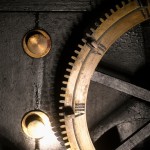
Phil Coy’s "60bpm 33rpm" begins with one of those sounds that civilisation has trained us to ignore: a clock ticking somewhere nearby. We normally hear such sounds only when they stop, which is perhaps the most revealing thing about our relationship with time. The clock is allowed to organise our lives precisely because we have agreed not to listen to it. Coy’s record asks what happens when we do.
The source is the Benjamin Vulliamy turret clock installed at St George’s Church in Ramsgate in 1829, and Coy’s original "sixty beats per minute" was a two-month, site-specific installation there in 2025. Microphones amplified the mechanism into the church nave while a digital timecode followed its rhythm. Every six minutes, however, the system changed direction, sending the previous six minutes backwards through the speakers. The installation effectively turned the church into an instrument whose principal musician was a piece of Victorian engineering.
On record, the spatial complexity inevitably changes. The surround installation becomes an 18-minute stereo piece, and the church itself is no longer physically present. Yet this loss is partly compensated by the peculiar physicality of vinyl. The 33rpm object contains concentric grooves that echo the circular mechanics of the clock, turning the record into something more than a carrier for the sound. It becomes a small, black machine for contemplating machinery. Coy’s first vinyl release therefore makes considerable sense as an object, even before the stylus begins its pilgrimage around the edge.
The first side is remarkably patient. The clock does not announce itself as an artistic device; it simply ticks, while Ramsgate leaks into the recording: birds, distant voices, traffic and the indistinct activity of a town going about its business. The important thing is that the clock does not sit above this material as some grand philosophical narrator. It is embedded in it. Human activity happens underneath the beat, just as it does in ordinary life, where deadlines, school runs, meals, sleep and minor catastrophes all take place under the supposedly neutral authority of the second hand. Then the reversal arrives.
It is an excellent trick because it is so physically wrong. Reversed sound has an immediately recognisable unnatural quality, but Coy avoids turning the effect into a mere piece of audio sleight-of-hand. The backward clock seems to expose the difference between recorded time and lived time. A recording can reverse what has happened. Experience cannot. You can replay an argument, a childhood, a bad decision or an entire decade as many times as you like, but nobody has yet discovered the rewind button for consequences. Human civilisation has managed to invent clocks, databases, surveillance cameras and cloud storage, but apparently not a decent undo function.
That tension gives "60bpm 33rpm" its real weight. The clock represents time as measurement, while the reversal exposes measurement as an agreement rather than an absolute law. Six minutes can be divided, displayed, recorded, repeated and inverted, but none of these operations actually returns the world to the state it occupied six minutes earlier. Coy’s work therefore creates a small but quite unnerving gap between chronological time and perceptual time.
This concern fits naturally within his broader practice. Coy is an interdisciplinary artist whose work moves between sculpture, photography, film, performance and site-sensitive sound, with particular attention to the histories and architectures of specific places. His permanent "Stereo Pair" at Brunel University, for example, emerged from the history of acoustic listening technologies and pre-radar sound mirrors, while his work more generally tends to make architecture behave less like a passive container and more like an active participant.
That background matters here because "60bpm 33rpm" is not really a field recording in the conventional sense. Coy is not merely documenting Ramsgate, nor is he using the clock as convenient atmospheric decoration. He constructs a situation in which the place, the mechanism and the recording technology interfere with one another. The clock produces the pulse; the microphones transform it; the software decides when the past will be replayed; the church colours the sound; and the vinyl subsequently gives the whole process another circular body. Each stage alters what came before.
And then Adrian Sherwood gets involved, which is where the supposedly disciplined clock starts losing its trousers.
The second side consists of four dub treatments of the material, produced and mixed by Sherwood at On-U Sound Studios with Mark Bandolla on guitar and keyboards, Duncan Mackay on trumpet, Alex White on saxophone and flute, and Ivan Hussey on cello. Sherwood is almost absurdly well suited to the task. Since the late 1970s, his work has been built around treating recorded sound as something elastic: delay, echo, repetition, subtraction, distortion and spatial displacement become compositional tools rather than post-production cosmetics.
His contribution changes the philosophical temperature of the project. Where Coy’s side makes time strange by reversing it, Sherwood makes it unstable by multiplying it. The clock’s regular pulse is fed through dub’s familiar machinery and comes back wearing different clothes. Bass, percussion, horns, guitar and echoes establish alternative trajectories around the original beat. The clock is still there, but its authority has been seriously compromised.
This is perhaps the smartest pairing in the project. Dub has always possessed an unusual relationship with chronology. It takes something already recorded and turns it into a new event, often making the studio itself audible in the process. Sherwood does not simply decorate Coy’s concept with reggae-derived effects. He applies a production philosophy that has been concerned for decades with breaking linear musical expectation. The result is a dialogue between two kinds of temporal sabotage: Coy reverses the clock; Sherwood makes the clock proliferate.
The four dub pieces also prevent the album from becoming overly solemn. There is a temptation in sound art involving churches, nineteenth-century clocks, existential time and the crisis of modern temporality to start speaking as though every ticking second were personally responsible for the decline of Western civilisation. Sherwood provides a useful corrective. Suddenly the great mechanical order is wobbling, echoing and acquiring horns. The clock has gone from authority figure to unreliable bandleader.
The locked groove at the end completes the joke with unusual precision. Instead of allowing time to proceed toward an ordinary conclusion, the record becomes physically incapable of reaching one. The stylus keeps circling the same tiny section, producing repetition without progress. It is both a literal property of the medium and an almost embarrassingly efficient metaphor for the human condition. We invented clocks to organise time, records to preserve it, and now the record gets stuck. Somewhere, a Victorian engineer is presumably filing a complaint.
What saves "60bpm 33rpm" from being merely clever is Coy’s sensitivity to sound as evidence. The distant life of Ramsgate remains crucial. The clock does not exist in abstraction; it is surrounded by the unpredictable noises of people, animals, weather and the town itself. When these sounds are reversed, their familiarity becomes subtly grotesque. The past does not return as memory. It returns as material that has been processed incorrectly.
That distinction is important. Coy is not claiming that time can be undone. He demonstrates how easily our perception of sequence can be manipulated. Six minutes forward and six minutes backward are technically composed of the same sonic material, yet they do not feel remotely equivalent. The difference lies not in the sounds themselves but in our expectation of causality. We expect footsteps to follow bodies, voices to emerge from mouths, birds to make noise before silence follows them. Reverse the order and the ordinary world becomes uncanny without any additional sound being introduced.
There is something quietly political in this, too. Mechanical clock time was historically tied to industrial discipline, punctuality, labour and the increasing standardisation of everyday life. The Ramsgate turret clock belongs to precisely that historical transformation, while its contemporary digital counterpart belongs to an era in which time has become even more pervasive: notifications, timestamps, calendars, productivity software, surveillance and the permanently available workplace. Coy’s machine is old, but the problem it exposes is painfully current.
The record does not offer an escape from this system. It does something more useful: it makes the system audible. And once time becomes audible, it stops seeming quite so inevitable.
"60bpm 33rpm" is therefore a modestly sized work with an unusually large subject. Its materials are simple: a clock, a town, a church, microphones, software, vinyl and a dub producer with an apparently inexhaustible supply of echoes. But their combination produces a strange little disturbance in our confidence that yesterday, today and tomorrow are as neatly separated as the numbers on a clockface suggest.
Time keeps moving, naturally. It has never listened to human requests.
But for roughly forty minutes, Coy and Sherwood make a convincing case for refusing to listen to it quite so obediently.
The source is the Benjamin Vulliamy turret clock installed at St George’s Church in Ramsgate in 1829, and Coy’s original "sixty beats per minute" was a two-month, site-specific installation there in 2025. Microphones amplified the mechanism into the church nave while a digital timecode followed its rhythm. Every six minutes, however, the system changed direction, sending the previous six minutes backwards through the speakers. The installation effectively turned the church into an instrument whose principal musician was a piece of Victorian engineering.
On record, the spatial complexity inevitably changes. The surround installation becomes an 18-minute stereo piece, and the church itself is no longer physically present. Yet this loss is partly compensated by the peculiar physicality of vinyl. The 33rpm object contains concentric grooves that echo the circular mechanics of the clock, turning the record into something more than a carrier for the sound. It becomes a small, black machine for contemplating machinery. Coy’s first vinyl release therefore makes considerable sense as an object, even before the stylus begins its pilgrimage around the edge.
The first side is remarkably patient. The clock does not announce itself as an artistic device; it simply ticks, while Ramsgate leaks into the recording: birds, distant voices, traffic and the indistinct activity of a town going about its business. The important thing is that the clock does not sit above this material as some grand philosophical narrator. It is embedded in it. Human activity happens underneath the beat, just as it does in ordinary life, where deadlines, school runs, meals, sleep and minor catastrophes all take place under the supposedly neutral authority of the second hand. Then the reversal arrives.
It is an excellent trick because it is so physically wrong. Reversed sound has an immediately recognisable unnatural quality, but Coy avoids turning the effect into a mere piece of audio sleight-of-hand. The backward clock seems to expose the difference between recorded time and lived time. A recording can reverse what has happened. Experience cannot. You can replay an argument, a childhood, a bad decision or an entire decade as many times as you like, but nobody has yet discovered the rewind button for consequences. Human civilisation has managed to invent clocks, databases, surveillance cameras and cloud storage, but apparently not a decent undo function.
That tension gives "60bpm 33rpm" its real weight. The clock represents time as measurement, while the reversal exposes measurement as an agreement rather than an absolute law. Six minutes can be divided, displayed, recorded, repeated and inverted, but none of these operations actually returns the world to the state it occupied six minutes earlier. Coy’s work therefore creates a small but quite unnerving gap between chronological time and perceptual time.
This concern fits naturally within his broader practice. Coy is an interdisciplinary artist whose work moves between sculpture, photography, film, performance and site-sensitive sound, with particular attention to the histories and architectures of specific places. His permanent "Stereo Pair" at Brunel University, for example, emerged from the history of acoustic listening technologies and pre-radar sound mirrors, while his work more generally tends to make architecture behave less like a passive container and more like an active participant.
That background matters here because "60bpm 33rpm" is not really a field recording in the conventional sense. Coy is not merely documenting Ramsgate, nor is he using the clock as convenient atmospheric decoration. He constructs a situation in which the place, the mechanism and the recording technology interfere with one another. The clock produces the pulse; the microphones transform it; the software decides when the past will be replayed; the church colours the sound; and the vinyl subsequently gives the whole process another circular body. Each stage alters what came before.
And then Adrian Sherwood gets involved, which is where the supposedly disciplined clock starts losing its trousers.
The second side consists of four dub treatments of the material, produced and mixed by Sherwood at On-U Sound Studios with Mark Bandolla on guitar and keyboards, Duncan Mackay on trumpet, Alex White on saxophone and flute, and Ivan Hussey on cello. Sherwood is almost absurdly well suited to the task. Since the late 1970s, his work has been built around treating recorded sound as something elastic: delay, echo, repetition, subtraction, distortion and spatial displacement become compositional tools rather than post-production cosmetics.
His contribution changes the philosophical temperature of the project. Where Coy’s side makes time strange by reversing it, Sherwood makes it unstable by multiplying it. The clock’s regular pulse is fed through dub’s familiar machinery and comes back wearing different clothes. Bass, percussion, horns, guitar and echoes establish alternative trajectories around the original beat. The clock is still there, but its authority has been seriously compromised.
This is perhaps the smartest pairing in the project. Dub has always possessed an unusual relationship with chronology. It takes something already recorded and turns it into a new event, often making the studio itself audible in the process. Sherwood does not simply decorate Coy’s concept with reggae-derived effects. He applies a production philosophy that has been concerned for decades with breaking linear musical expectation. The result is a dialogue between two kinds of temporal sabotage: Coy reverses the clock; Sherwood makes the clock proliferate.
The four dub pieces also prevent the album from becoming overly solemn. There is a temptation in sound art involving churches, nineteenth-century clocks, existential time and the crisis of modern temporality to start speaking as though every ticking second were personally responsible for the decline of Western civilisation. Sherwood provides a useful corrective. Suddenly the great mechanical order is wobbling, echoing and acquiring horns. The clock has gone from authority figure to unreliable bandleader.
The locked groove at the end completes the joke with unusual precision. Instead of allowing time to proceed toward an ordinary conclusion, the record becomes physically incapable of reaching one. The stylus keeps circling the same tiny section, producing repetition without progress. It is both a literal property of the medium and an almost embarrassingly efficient metaphor for the human condition. We invented clocks to organise time, records to preserve it, and now the record gets stuck. Somewhere, a Victorian engineer is presumably filing a complaint.
What saves "60bpm 33rpm" from being merely clever is Coy’s sensitivity to sound as evidence. The distant life of Ramsgate remains crucial. The clock does not exist in abstraction; it is surrounded by the unpredictable noises of people, animals, weather and the town itself. When these sounds are reversed, their familiarity becomes subtly grotesque. The past does not return as memory. It returns as material that has been processed incorrectly.
That distinction is important. Coy is not claiming that time can be undone. He demonstrates how easily our perception of sequence can be manipulated. Six minutes forward and six minutes backward are technically composed of the same sonic material, yet they do not feel remotely equivalent. The difference lies not in the sounds themselves but in our expectation of causality. We expect footsteps to follow bodies, voices to emerge from mouths, birds to make noise before silence follows them. Reverse the order and the ordinary world becomes uncanny without any additional sound being introduced.
There is something quietly political in this, too. Mechanical clock time was historically tied to industrial discipline, punctuality, labour and the increasing standardisation of everyday life. The Ramsgate turret clock belongs to precisely that historical transformation, while its contemporary digital counterpart belongs to an era in which time has become even more pervasive: notifications, timestamps, calendars, productivity software, surveillance and the permanently available workplace. Coy’s machine is old, but the problem it exposes is painfully current.
The record does not offer an escape from this system. It does something more useful: it makes the system audible. And once time becomes audible, it stops seeming quite so inevitable.
"60bpm 33rpm" is therefore a modestly sized work with an unusually large subject. Its materials are simple: a clock, a town, a church, microphones, software, vinyl and a dub producer with an apparently inexhaustible supply of echoes. But their combination produces a strange little disturbance in our confidence that yesterday, today and tomorrow are as neatly separated as the numbers on a clockface suggest.
Time keeps moving, naturally. It has never listened to human requests.
But for roughly forty minutes, Coy and Sherwood make a convincing case for refusing to listen to it quite so obediently.
Manja Ristić: lights shimmered like whispers in the depths of the trees
Artist: Manja Ristić (@)
Title: lights shimmered like whispers in the depths of the trees
Format: CD + Download
Label: Sawyer Editions
Rated:
Title: lights shimmered like whispers in the depths of the trees
Format: CD + Download
Label: Sawyer Editions
Rated:
There are albums about memory, and then there are albums that seem to understand that memory is a rather untidy substance. It does not sit politely in chronological order, waiting for somebody to retrieve it. It leaks into bodies, places, habits, landscapes and family stories, occasionally resurfacing because a particular sound, smell or patch of ground has decided that the past is not finished with us yet. "lights shimmered like whispers in the depths of the trees", the latest work by Manja Ristic, belongs firmly to the second category.
Ristic is a Belgrade-born violinist, sound artist, curator and researcher whose work has for years occupied the borderlands between electroacoustic composition, improvisation, field recording and sound installation. Trained at the Belgrade Music Academy and later at the Royal College of Music in London, she has developed a particularly recognisable practice around environmental listening, hydrophone recordings, violin, analogue electronics and found materials. Her recent work has repeatedly returned to questions of ecological damage, memory and the historical traces embedded in landscapes, but without treating field recordings as postcards from interesting places.
That distinction matters here because "lights shimmered..." is ostensibly concerned with something deeply personal: Ristic's grandmother Negosava, born Stefanovi, and the generation of young people who helped rebuild post-war Yugoslavia with their labour. There are abandoned railway lines, forests, industrial remnants and the uneasy inheritance of a country whose physical reconstruction became part of its mythology. It would have been very easy to turn this into a sonic documentary, complete with archival voices and appropriately sorrowful historical punctuation. Ristic chooses something much less literal.
The album consists of just two pieces, “thick green bed of a land” and “bore its wounds in silence”, running sixteen and twenty-three minutes respectively. Their titles already establish the basic tension: vegetation and injury, shelter and damage, fertility and historical violence. Yet the music does not translate those oppositions into obvious effects. Instead, it lets them accumulate gradually, through field recordings gathered across Italy, Portugal, Croatia and Austria, underwater recordings from rivers and coastal environments, violin and cello, the extraordinary EMS Synthi 100 from the Electronic Studio of Radio Belgrade, and a piano once belonging to Austrian artist Karl Katzinger, also known as John Tylo.
The geographical spread is considerable, but the album never feels like an audio scrapbook. This is partly because Ristic is remarkably careful about the density of her materials. Water is not simply “water”; vegetation is not simply “nature”; industrial spaces are not automatically made to sound sinister. The recordings are allowed to retain their ambiguity. A distant movement may be mechanical or organic. A vibration might belong to an instrument, a structure, a current or some combination of all four. The listener is repeatedly placed in the uncomfortable but productive position of having to decide what exactly is being heard.
“Thick green bed of a land” develops with particular patience. Environmental sounds emerge and recede without the reassuring hierarchy of foreground and background that conventional composition tends to impose. The electronic material does not arrive to announce itself as the “musical” component. It inhabits the same acoustic territory as the recordings, sometimes almost indistinguishably. Violin and other instrumental sounds appear less as melodies than as extensions of the surrounding acoustic environment, allowing pitch to materialise briefly before being absorbed again into texture.
This is one of Ristic's great strengths. She has a talent for making instrumental sounds feel as though they have been discovered rather than inserted. Her previous works, including "Dew" and "Sargassum aeterna", have used violin, EMS Synthi 100 and hydrophone recordings to construct similarly porous relationships between composed material and environmental sound. In "Dew", for instance, train stations, lakes, rain, underwater sounds and instrumental material become part of an intimate meditation on memory rather than functioning as illustrative effects. "Sargassum aeterna" expanded the method into a darker ecological imagination, using field and hydrophone recordings from several locations alongside violin and electronics.
Here the emotional charge is more familial, and consequently more difficult to keep at arm's length. The dedication to Negosava gives the album a human centre, but Ristic wisely avoids sentimentalising her grandmother. There is no attempt to reconstruct her life in musical form. Instead, the work asks what remains when the individual is gone but the places, gestures and consequences of a generation's actions remain.
That question becomes particularly resonant in the references to railway construction. The abandoned tracks in the accompanying narrative are almost brutally ordinary. People built them because they believed they would carry something into the future; eventually the trains never came, the infrastructure was abandoned, and the material was dismantled or sold. History is full of such projects, although official history tends to photograph the successful ones and quietly forget the rest. Ristic's music is interested in precisely that residue.
The forest, consequently, is not presented as an untouched refuge standing outside history. It remembers the human presence that preceded it. The railway, meanwhile, is not simply a symbol of failed modernity. It becomes another layer in the landscape, alongside roots, water, industrial contamination, footsteps and stories. Nature and history are not opposites here. They have been rubbing against each other for decades.
“Bore its wounds in silence” deepens this idea. The second piece is less concerned with establishing a particular location than with allowing sounds to accumulate into something resembling geological memory. Hydrophone recordings are especially effective because underwater sound immediately disrupts our normal assumptions about distance. Familiar phenomena become strange when heard through water. A vibration can seem enormous, intimate or impossibly remote. Ristic uses that acoustic uncertainty to loosen the boundary between physical environment and recollection.
There is also something quietly unsettling about the album's use of the body. The text accompanying the work invokes epigenetics, ancestral experience and the transmission of memory across generations. Scientifically, that territory needs more caution than poetic language usually provides. Human beings are not literally carrying their grandparents' memories around in their DNA like tiny family USB sticks. But as an artistic proposition, the idea becomes considerably more interesting when Ristic translates it into sound. What does inherited experience feel like when it cannot be narrated directly? Perhaps something like a recurring vibration whose original source has disappeared.
The album never attempts to answer that question definitively. Instead, it creates conditions in which the question can remain audible.
This is also why the environmental recordings avoid becoming merely picturesque. Recent writing on Ristic's work has noted the tension between the recognisable world captured by her microphones and the subtle transformations that turn those recordings into compositions. One particularly perceptive response to this release points out that the autobiographical and genealogical material is communicated through atmosphere rather than explicit narrative, allowing the listener to recognise that these are constructed works rather than straightforward documentary recordings.
That is probably the best way to approach "lights shimmered...". It is not a story being told through sound. It is a story being allowed to lose its edges.
The use of the EMS Synthi 100 is significant in this respect. The instrument carries its own historical associations, particularly within the experimental tradition of the Electronic Studio of Radio Belgrade, but Ristic does not treat it as an exotic relic to be wheeled onto the stage whenever the music needs an official certificate of experimentalism. Its electronic tones enter into dialogue with the hydrophone recordings, acoustic instruments and environmental sounds. Technology becomes another historical layer rather than a sign of progress.
The same applies to the piano once owned by Karl Katzinger. Its provenance could easily become a piece of collector trivia, but within Ristic's larger practice it makes sense as another object carrying traces of previous lives. The instruments are not merely tools for producing sounds. They arrive already burdened with histories.
And this may be where the album's title becomes most convincing. The lights in the trees are not presented as a beautiful visual spectacle. They are fleeting signs of something that cannot be held still. A memory behaves similarly. It appears, changes the emotional temperature of a moment, and disappears before one can inspect it properly. The title's whispered shimmer is therefore less decorative than it initially sounds.
There is, however, nothing especially whispery about some of the album's underlying tensions. Industrial spaces, toxic residues, post-war reconstruction and ecological transformation remain present even when the music becomes quiet. Ristic's earlier work has often approached environmental crisis without resorting to the conventional vocabulary of catastrophe, and that restraint remains valuable here. A ruined landscape does not need to scream in order to tell us that something happened there.
In fact, the quietness can make the political dimension more effective. Grand declarations tend to tell us what we should think. Ristic's landscapes instead ask us to notice what is still there. The abandoned railway, the forest, the contaminated industrial structure, the river, the body: none of them delivers a speech. They simply continue existing after the people who gave them their original meaning have moved on.
There is a gentle irony in the album's treatment of endurance. The humans imagine themselves as builders, destroyers, historians and owners; the landscape simply waits long enough to outlive most of those categories. The railway disappears. The forest remains. The grandmother dies. The story continues. The toxic residue persists with the stubbornness of a particularly unpleasant family heirloom.
Still, "lights shimmered like whispers in the depths of the trees" is not pessimistic in any straightforward sense. Its melancholy is balanced by an extraordinary attentiveness to survival. The title image itself contains light. The green bed of the land is thick, not dead. Water continues to move. Sounds continue to circulate. The past may be wounded, distorted and incomplete, but it has not become silent.
Ristic's most impressive achievement is therefore one of scale. She can move from the intimate body to a river, from a grandmother to a generation, from a railway embankment to the long history of a landscape without making any of those things feel like merely convenient symbols. Everything remains material. Wood, water, metal, skin, strings, soil, circuitry and memory occupy the same perceptual field.
Two long tracks are enough because the album is not really interested in giving us more events. It is interested in making the existing ones last long enough for their relationships to become visible. That requires patience, but not the kind usually associated with “slow music”. The patience here belongs to observation. Ristic listens until the distinctions between environment, instrument and recollection become unstable.
And perhaps that is what inheritance actually sounds like: not a message passed intact from one generation to another, but a collection of faint disturbances whose original causes have become difficult to identify. Someone built a railway. Someone walked through a forest. Someone remembered. Someone recorded the water. Someone else listens decades later and discovers that none of these things has entirely disappeared.
The forest, after all, does not need to remember in the human sense. It only needs to remain.
Ristic is a Belgrade-born violinist, sound artist, curator and researcher whose work has for years occupied the borderlands between electroacoustic composition, improvisation, field recording and sound installation. Trained at the Belgrade Music Academy and later at the Royal College of Music in London, she has developed a particularly recognisable practice around environmental listening, hydrophone recordings, violin, analogue electronics and found materials. Her recent work has repeatedly returned to questions of ecological damage, memory and the historical traces embedded in landscapes, but without treating field recordings as postcards from interesting places.
That distinction matters here because "lights shimmered..." is ostensibly concerned with something deeply personal: Ristic's grandmother Negosava, born Stefanovi, and the generation of young people who helped rebuild post-war Yugoslavia with their labour. There are abandoned railway lines, forests, industrial remnants and the uneasy inheritance of a country whose physical reconstruction became part of its mythology. It would have been very easy to turn this into a sonic documentary, complete with archival voices and appropriately sorrowful historical punctuation. Ristic chooses something much less literal.
The album consists of just two pieces, “thick green bed of a land” and “bore its wounds in silence”, running sixteen and twenty-three minutes respectively. Their titles already establish the basic tension: vegetation and injury, shelter and damage, fertility and historical violence. Yet the music does not translate those oppositions into obvious effects. Instead, it lets them accumulate gradually, through field recordings gathered across Italy, Portugal, Croatia and Austria, underwater recordings from rivers and coastal environments, violin and cello, the extraordinary EMS Synthi 100 from the Electronic Studio of Radio Belgrade, and a piano once belonging to Austrian artist Karl Katzinger, also known as John Tylo.
The geographical spread is considerable, but the album never feels like an audio scrapbook. This is partly because Ristic is remarkably careful about the density of her materials. Water is not simply “water”; vegetation is not simply “nature”; industrial spaces are not automatically made to sound sinister. The recordings are allowed to retain their ambiguity. A distant movement may be mechanical or organic. A vibration might belong to an instrument, a structure, a current or some combination of all four. The listener is repeatedly placed in the uncomfortable but productive position of having to decide what exactly is being heard.
“Thick green bed of a land” develops with particular patience. Environmental sounds emerge and recede without the reassuring hierarchy of foreground and background that conventional composition tends to impose. The electronic material does not arrive to announce itself as the “musical” component. It inhabits the same acoustic territory as the recordings, sometimes almost indistinguishably. Violin and other instrumental sounds appear less as melodies than as extensions of the surrounding acoustic environment, allowing pitch to materialise briefly before being absorbed again into texture.
This is one of Ristic's great strengths. She has a talent for making instrumental sounds feel as though they have been discovered rather than inserted. Her previous works, including "Dew" and "Sargassum aeterna", have used violin, EMS Synthi 100 and hydrophone recordings to construct similarly porous relationships between composed material and environmental sound. In "Dew", for instance, train stations, lakes, rain, underwater sounds and instrumental material become part of an intimate meditation on memory rather than functioning as illustrative effects. "Sargassum aeterna" expanded the method into a darker ecological imagination, using field and hydrophone recordings from several locations alongside violin and electronics.
Here the emotional charge is more familial, and consequently more difficult to keep at arm's length. The dedication to Negosava gives the album a human centre, but Ristic wisely avoids sentimentalising her grandmother. There is no attempt to reconstruct her life in musical form. Instead, the work asks what remains when the individual is gone but the places, gestures and consequences of a generation's actions remain.
That question becomes particularly resonant in the references to railway construction. The abandoned tracks in the accompanying narrative are almost brutally ordinary. People built them because they believed they would carry something into the future; eventually the trains never came, the infrastructure was abandoned, and the material was dismantled or sold. History is full of such projects, although official history tends to photograph the successful ones and quietly forget the rest. Ristic's music is interested in precisely that residue.
The forest, consequently, is not presented as an untouched refuge standing outside history. It remembers the human presence that preceded it. The railway, meanwhile, is not simply a symbol of failed modernity. It becomes another layer in the landscape, alongside roots, water, industrial contamination, footsteps and stories. Nature and history are not opposites here. They have been rubbing against each other for decades.
“Bore its wounds in silence” deepens this idea. The second piece is less concerned with establishing a particular location than with allowing sounds to accumulate into something resembling geological memory. Hydrophone recordings are especially effective because underwater sound immediately disrupts our normal assumptions about distance. Familiar phenomena become strange when heard through water. A vibration can seem enormous, intimate or impossibly remote. Ristic uses that acoustic uncertainty to loosen the boundary between physical environment and recollection.
There is also something quietly unsettling about the album's use of the body. The text accompanying the work invokes epigenetics, ancestral experience and the transmission of memory across generations. Scientifically, that territory needs more caution than poetic language usually provides. Human beings are not literally carrying their grandparents' memories around in their DNA like tiny family USB sticks. But as an artistic proposition, the idea becomes considerably more interesting when Ristic translates it into sound. What does inherited experience feel like when it cannot be narrated directly? Perhaps something like a recurring vibration whose original source has disappeared.
The album never attempts to answer that question definitively. Instead, it creates conditions in which the question can remain audible.
This is also why the environmental recordings avoid becoming merely picturesque. Recent writing on Ristic's work has noted the tension between the recognisable world captured by her microphones and the subtle transformations that turn those recordings into compositions. One particularly perceptive response to this release points out that the autobiographical and genealogical material is communicated through atmosphere rather than explicit narrative, allowing the listener to recognise that these are constructed works rather than straightforward documentary recordings.
That is probably the best way to approach "lights shimmered...". It is not a story being told through sound. It is a story being allowed to lose its edges.
The use of the EMS Synthi 100 is significant in this respect. The instrument carries its own historical associations, particularly within the experimental tradition of the Electronic Studio of Radio Belgrade, but Ristic does not treat it as an exotic relic to be wheeled onto the stage whenever the music needs an official certificate of experimentalism. Its electronic tones enter into dialogue with the hydrophone recordings, acoustic instruments and environmental sounds. Technology becomes another historical layer rather than a sign of progress.
The same applies to the piano once owned by Karl Katzinger. Its provenance could easily become a piece of collector trivia, but within Ristic's larger practice it makes sense as another object carrying traces of previous lives. The instruments are not merely tools for producing sounds. They arrive already burdened with histories.
And this may be where the album's title becomes most convincing. The lights in the trees are not presented as a beautiful visual spectacle. They are fleeting signs of something that cannot be held still. A memory behaves similarly. It appears, changes the emotional temperature of a moment, and disappears before one can inspect it properly. The title's whispered shimmer is therefore less decorative than it initially sounds.
There is, however, nothing especially whispery about some of the album's underlying tensions. Industrial spaces, toxic residues, post-war reconstruction and ecological transformation remain present even when the music becomes quiet. Ristic's earlier work has often approached environmental crisis without resorting to the conventional vocabulary of catastrophe, and that restraint remains valuable here. A ruined landscape does not need to scream in order to tell us that something happened there.
In fact, the quietness can make the political dimension more effective. Grand declarations tend to tell us what we should think. Ristic's landscapes instead ask us to notice what is still there. The abandoned railway, the forest, the contaminated industrial structure, the river, the body: none of them delivers a speech. They simply continue existing after the people who gave them their original meaning have moved on.
There is a gentle irony in the album's treatment of endurance. The humans imagine themselves as builders, destroyers, historians and owners; the landscape simply waits long enough to outlive most of those categories. The railway disappears. The forest remains. The grandmother dies. The story continues. The toxic residue persists with the stubbornness of a particularly unpleasant family heirloom.
Still, "lights shimmered like whispers in the depths of the trees" is not pessimistic in any straightforward sense. Its melancholy is balanced by an extraordinary attentiveness to survival. The title image itself contains light. The green bed of the land is thick, not dead. Water continues to move. Sounds continue to circulate. The past may be wounded, distorted and incomplete, but it has not become silent.
Ristic's most impressive achievement is therefore one of scale. She can move from the intimate body to a river, from a grandmother to a generation, from a railway embankment to the long history of a landscape without making any of those things feel like merely convenient symbols. Everything remains material. Wood, water, metal, skin, strings, soil, circuitry and memory occupy the same perceptual field.
Two long tracks are enough because the album is not really interested in giving us more events. It is interested in making the existing ones last long enough for their relationships to become visible. That requires patience, but not the kind usually associated with “slow music”. The patience here belongs to observation. Ristic listens until the distinctions between environment, instrument and recollection become unstable.
And perhaps that is what inheritance actually sounds like: not a message passed intact from one generation to another, but a collection of faint disturbances whose original causes have become difficult to identify. Someone built a railway. Someone walked through a forest. Someone remembered. Someone recorded the water. Someone else listens decades later and discovers that none of these things has entirely disappeared.
The forest, after all, does not need to remember in the human sense. It only needs to remain.
Etienne Nillesen: Twee
Artist: Etienne Nillesen
Title: Twee
Format: Download Only (MP3 + Lossless)
Label: SOFA Music (@)
Rated:

Title: Twee
Format: Download Only (MP3 + Lossless)
Label: SOFA Music (@)
Rated:
A snare drum is usually asked to do one of two things: keep time or make a loud, emphatic noise while somebody else gets to have the melody. Etienne Nillesen has spent years politely refusing both assignments. With "TWEE", he takes two snare drums, tunes them in close relation, and spends thirty-five minutes discovering how much musical information can be extracted from an instrument that most of us have been trained to recognise by its characteristic little burst of military punctuation.
The title is a useful place to start, if only because "twee" is an almost comically inappropriate word for what follows. In English, it describes something excessively cute or precious, the sort of adjective that might be applied to a miniature teacup, a knitted animal or a song that has been aggressively instructed to have feelings. There is very little of that here. The title's mismatch may be deliberate, accidental or simply Nillesen having a sense of humour. In any case, the music quickly settles the matter: this is not twee, unless one has developed a remarkably liberal definition of cuteness.
Nillesen is a Dutch percussionist, composer and sound artist based in Cologne whose career has moved progressively away from the conventional drum kit. He began playing drums as a child, studied jazz and subsequently became increasingly fascinated by the possibilities contained within a much smaller setup. The reduction was not an aesthetic stunt but part of a long process of finding out what he actually needed to say. Eventually the snare became the central instrument of his practice, and his work now occupies an unusually fertile point between improvisation, contemporary composition and sound art. He has collaborated with musicians including Rudi Mahall, Simon Nabatov, Philip Zoubek, Elisabeth Coudoux, Kaja Draksler and many others, while also developing an extensive solo practice around the extended snare drum.
His previous "en", released by Sofa Music in 2024, already demonstrated how far this investigation could go with a single snare. "TWEE" adds a second drum, and that apparently modest numerical increase changes the physics of the situation considerably. The two instruments are tuned close to one another, producing beating patterns and shifting relationships between their partials. Nillesen does not simply strike them and wait for interesting things to happen. He applies sustained pressure, moves in circular patterns across different parts of the drumheads and adjusts the contact points so gradually that the listener begins to hear pitch where there ought, according to the percussion department of common sense, to be nothing but membrane and metal.
This is where "TWEE" becomes more than an extended demonstration of unusual technique. The sound does not proceed through a succession of discrete events. It behaves more like a continuously changing condition. A tone appears, another begins to interfere with it, a pulse emerges from their disagreement, and then the whole relationship shifts. What initially seems static reveals itself to be packed with microscopic activity. The closer one listens, the less “minimal” the piece becomes.
That paradox is central to Nillesen's music. The means are extremely limited, but the perceptual consequences are not. The instrument remains recognisable throughout, yet its familiar identity gradually becomes irrelevant. You can still hear the snare drum, but you stop hearing it as “a snare drum”. It becomes a resonating surface with pitch, grain, friction, sympathetic vibration and a surprisingly elaborate internal weather system.
The recording venue matters. "TWEE" was recorded at the Deutschlandfunk Kammermusiksaal in Cologne, the same chamber-music hall used for "en", and the acoustics are not merely a neutral container around the performance. They participate in it. The resonance of the room allows small differences between the two drums to become legible, while the sustained tones expose the relationship between direct sound and reflected sound. This is music in which the room has almost as much patience as the musician.
Nillesen's technique is physical, but the result is strangely disembodied. One can imagine the movements required to create these sounds, yet the recorded music encourages a different kind of attention, because the gestures themselves have disappeared. What remains is friction transformed into tone, pressure transformed into duration, and tiny movements transformed into a shifting field of pitch. It is one of those cases in which knowing how the sound is produced makes the listening more fascinating rather than less mysterious.
There is also a quiet rhythmic dimension here, although calling "TWEE" rhythmic music would be misleading. The beating between closely tuned drums generates pulses that appear without being explicitly played. Their frequency can change as the intonation changes, so rhythm is not imposed upon the sound from outside. It grows out of the acoustic relationship between the two instruments. Nillesen effectively discovers rhythm inside pitch.
This connects "TWEE" to a much older experimental tradition in which musicians stop accepting the conventional distinction between sound and musical event. But Nillesen avoids the solemnity that can sometimes accompany such investigations. He is not trying to convince us that a drum is secretly a philosophical object. He is simply listening to it closely enough to discover that it has been hiding things in plain sight.
That sense of discovery is perhaps the strongest aspect of the piece. There are no obvious climaxes to reward impatient listeners, no sudden changes inserted to reassure us that something is happening. Instead, the music asks whether our attention can become sensitive enough to register change at a scale normally dismissed as insignificant. A slight alteration in pressure can modify the overtone balance. A different position on the membrane can change the apparent pitch. Two nearly related frequencies can produce a third sensation, a wavering that is neither exactly one sound nor the other.
The effect can be hypnotic, but “hypnotic” is only part of the story. There are moments when the resonance becomes abrasive, almost metallic, and the apparently serene surface develops a harder edge. Other passages produce sounds that seem closer to voices, electronic oscillations or some malfunctioning piece of machinery than to percussion. Recent criticism has rightly noticed that the piece can move from sustained, delicate vibration towards much harsher and more insistent textures, preventing the work from settling into the comfortable category of ambient meditation.
This is important because "TWEE" could easily have become a rather respectable exercise in contemplative minimalism. It does not. Nillesen's concentration is rigorous, but the sounds themselves remain unpredictable. The drums occasionally seem to resist the performer, producing unstable resonances that have to be followed rather than completely controlled. The music therefore has an element of negotiation: Nillesen proposes a condition and then responds to what the instruments give him back.
That quality is consistent with his wider approach to improvisation. He has described his attraction to the freedom of creating music in the moment, but also to the idea that improvisation requires preparation and discipline rather than simply waiting for inspiration to descend from the heavens, presumably after checking its parking arrangements. His solo work turns that principle into an unusually concentrated practice. The material is carefully developed, yet the precise behaviour of the resonating drums cannot be entirely predicted.
The 35-minute duration is therefore well judged. A shorter piece might merely demonstrate the technique. A much longer one could begin to demand an almost monastic level of commitment from the listener. Here there is enough time for the ear to recalibrate itself. What initially sounds like a sustained tone gradually separates into layers, then those layers become relationships, and eventually those relationships become the real composition.
The achievement is especially striking because Nillesen does not conceal the limitations of his chosen instrument. He embraces them. The snare has a finite surface, a finite resonance and a very familiar cultural identity. Instead of escaping those constraints, he investigates them so thoroughly that they become sources of freedom. The narrower the vocabulary becomes, the more finely he is able to distinguish its smallest variations.
That makes "TWEE" an unusually good example of what experimental music can accomplish when experimentation is based on sustained curiosity rather than novelty for its own sake. There is nothing particularly spectacular about the premise. Two snares. One musician. One continuous piece. No electronics, no ensemble, no elaborate technology. Human civilisation has spent centuries developing increasingly complicated instruments and recording systems, only for Nillesen to turn around and ask what happens if we pay very close attention to two pieces of stretched material. The answer is unexpectedly rich.
By the end, the snare drum has not been reinvented so much as patiently reintroduced to us. We thought we knew its sound because we had heard it thousands of times. Nillesen demonstrates that familiarity is often just laziness with good public relations. "TWEE" makes the ordinary strange without disguising it, and makes minimal means feel expansive without inflating them into something grandiose. It is music that rewards concentration without demanding reverence. The listener does not need to meditate, light a candle or acquire a sudden interest in Tibetan philosophy. Sitting still and listening carefully is already sufficient. The rest happens inside the sound: two nearly related bodies rubbing against one another until pitch, rhythm, resonance and texture become difficult to separate.
Perhaps that is what "TWEE" ultimately has in common with the best experimental work. It does not give us more things to hear. It teaches us to hear more things in what was already there.
The title is a useful place to start, if only because "twee" is an almost comically inappropriate word for what follows. In English, it describes something excessively cute or precious, the sort of adjective that might be applied to a miniature teacup, a knitted animal or a song that has been aggressively instructed to have feelings. There is very little of that here. The title's mismatch may be deliberate, accidental or simply Nillesen having a sense of humour. In any case, the music quickly settles the matter: this is not twee, unless one has developed a remarkably liberal definition of cuteness.
Nillesen is a Dutch percussionist, composer and sound artist based in Cologne whose career has moved progressively away from the conventional drum kit. He began playing drums as a child, studied jazz and subsequently became increasingly fascinated by the possibilities contained within a much smaller setup. The reduction was not an aesthetic stunt but part of a long process of finding out what he actually needed to say. Eventually the snare became the central instrument of his practice, and his work now occupies an unusually fertile point between improvisation, contemporary composition and sound art. He has collaborated with musicians including Rudi Mahall, Simon Nabatov, Philip Zoubek, Elisabeth Coudoux, Kaja Draksler and many others, while also developing an extensive solo practice around the extended snare drum.
His previous "en", released by Sofa Music in 2024, already demonstrated how far this investigation could go with a single snare. "TWEE" adds a second drum, and that apparently modest numerical increase changes the physics of the situation considerably. The two instruments are tuned close to one another, producing beating patterns and shifting relationships between their partials. Nillesen does not simply strike them and wait for interesting things to happen. He applies sustained pressure, moves in circular patterns across different parts of the drumheads and adjusts the contact points so gradually that the listener begins to hear pitch where there ought, according to the percussion department of common sense, to be nothing but membrane and metal.
This is where "TWEE" becomes more than an extended demonstration of unusual technique. The sound does not proceed through a succession of discrete events. It behaves more like a continuously changing condition. A tone appears, another begins to interfere with it, a pulse emerges from their disagreement, and then the whole relationship shifts. What initially seems static reveals itself to be packed with microscopic activity. The closer one listens, the less “minimal” the piece becomes.
That paradox is central to Nillesen's music. The means are extremely limited, but the perceptual consequences are not. The instrument remains recognisable throughout, yet its familiar identity gradually becomes irrelevant. You can still hear the snare drum, but you stop hearing it as “a snare drum”. It becomes a resonating surface with pitch, grain, friction, sympathetic vibration and a surprisingly elaborate internal weather system.
The recording venue matters. "TWEE" was recorded at the Deutschlandfunk Kammermusiksaal in Cologne, the same chamber-music hall used for "en", and the acoustics are not merely a neutral container around the performance. They participate in it. The resonance of the room allows small differences between the two drums to become legible, while the sustained tones expose the relationship between direct sound and reflected sound. This is music in which the room has almost as much patience as the musician.
Nillesen's technique is physical, but the result is strangely disembodied. One can imagine the movements required to create these sounds, yet the recorded music encourages a different kind of attention, because the gestures themselves have disappeared. What remains is friction transformed into tone, pressure transformed into duration, and tiny movements transformed into a shifting field of pitch. It is one of those cases in which knowing how the sound is produced makes the listening more fascinating rather than less mysterious.
There is also a quiet rhythmic dimension here, although calling "TWEE" rhythmic music would be misleading. The beating between closely tuned drums generates pulses that appear without being explicitly played. Their frequency can change as the intonation changes, so rhythm is not imposed upon the sound from outside. It grows out of the acoustic relationship between the two instruments. Nillesen effectively discovers rhythm inside pitch.
This connects "TWEE" to a much older experimental tradition in which musicians stop accepting the conventional distinction between sound and musical event. But Nillesen avoids the solemnity that can sometimes accompany such investigations. He is not trying to convince us that a drum is secretly a philosophical object. He is simply listening to it closely enough to discover that it has been hiding things in plain sight.
That sense of discovery is perhaps the strongest aspect of the piece. There are no obvious climaxes to reward impatient listeners, no sudden changes inserted to reassure us that something is happening. Instead, the music asks whether our attention can become sensitive enough to register change at a scale normally dismissed as insignificant. A slight alteration in pressure can modify the overtone balance. A different position on the membrane can change the apparent pitch. Two nearly related frequencies can produce a third sensation, a wavering that is neither exactly one sound nor the other.
The effect can be hypnotic, but “hypnotic” is only part of the story. There are moments when the resonance becomes abrasive, almost metallic, and the apparently serene surface develops a harder edge. Other passages produce sounds that seem closer to voices, electronic oscillations or some malfunctioning piece of machinery than to percussion. Recent criticism has rightly noticed that the piece can move from sustained, delicate vibration towards much harsher and more insistent textures, preventing the work from settling into the comfortable category of ambient meditation.
This is important because "TWEE" could easily have become a rather respectable exercise in contemplative minimalism. It does not. Nillesen's concentration is rigorous, but the sounds themselves remain unpredictable. The drums occasionally seem to resist the performer, producing unstable resonances that have to be followed rather than completely controlled. The music therefore has an element of negotiation: Nillesen proposes a condition and then responds to what the instruments give him back.
That quality is consistent with his wider approach to improvisation. He has described his attraction to the freedom of creating music in the moment, but also to the idea that improvisation requires preparation and discipline rather than simply waiting for inspiration to descend from the heavens, presumably after checking its parking arrangements. His solo work turns that principle into an unusually concentrated practice. The material is carefully developed, yet the precise behaviour of the resonating drums cannot be entirely predicted.
The 35-minute duration is therefore well judged. A shorter piece might merely demonstrate the technique. A much longer one could begin to demand an almost monastic level of commitment from the listener. Here there is enough time for the ear to recalibrate itself. What initially sounds like a sustained tone gradually separates into layers, then those layers become relationships, and eventually those relationships become the real composition.
The achievement is especially striking because Nillesen does not conceal the limitations of his chosen instrument. He embraces them. The snare has a finite surface, a finite resonance and a very familiar cultural identity. Instead of escaping those constraints, he investigates them so thoroughly that they become sources of freedom. The narrower the vocabulary becomes, the more finely he is able to distinguish its smallest variations.
That makes "TWEE" an unusually good example of what experimental music can accomplish when experimentation is based on sustained curiosity rather than novelty for its own sake. There is nothing particularly spectacular about the premise. Two snares. One musician. One continuous piece. No electronics, no ensemble, no elaborate technology. Human civilisation has spent centuries developing increasingly complicated instruments and recording systems, only for Nillesen to turn around and ask what happens if we pay very close attention to two pieces of stretched material. The answer is unexpectedly rich.
By the end, the snare drum has not been reinvented so much as patiently reintroduced to us. We thought we knew its sound because we had heard it thousands of times. Nillesen demonstrates that familiarity is often just laziness with good public relations. "TWEE" makes the ordinary strange without disguising it, and makes minimal means feel expansive without inflating them into something grandiose. It is music that rewards concentration without demanding reverence. The listener does not need to meditate, light a candle or acquire a sudden interest in Tibetan philosophy. Sitting still and listening carefully is already sufficient. The rest happens inside the sound: two nearly related bodies rubbing against one another until pitch, rhythm, resonance and texture become difficult to separate.
Perhaps that is what "TWEE" ultimately has in common with the best experimental work. It does not give us more things to hear. It teaches us to hear more things in what was already there.